About Balea perversa (Linnaeus, 1758)
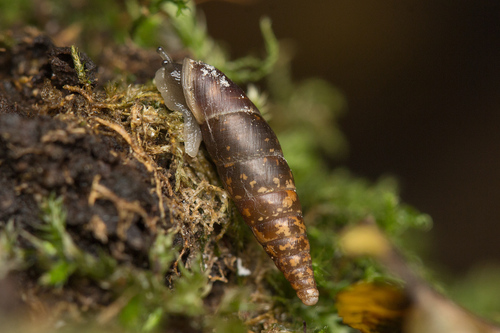
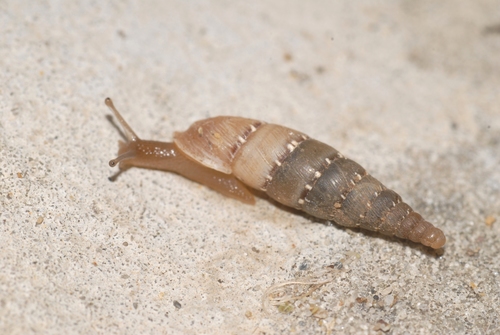
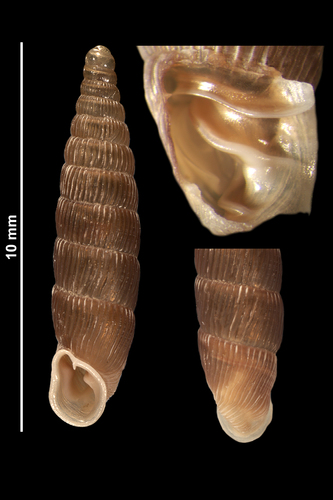
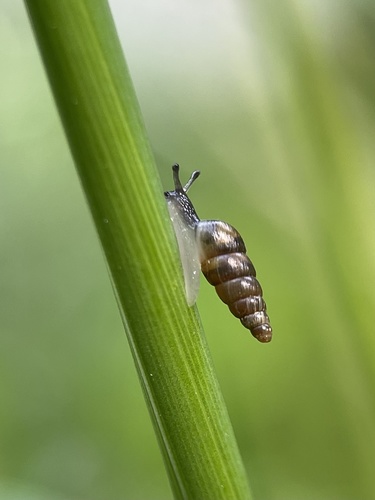
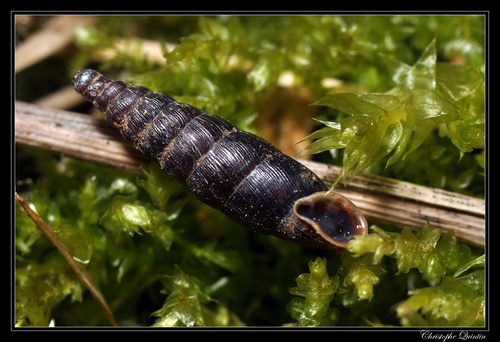
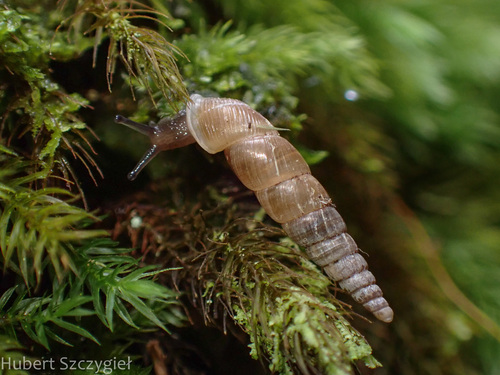
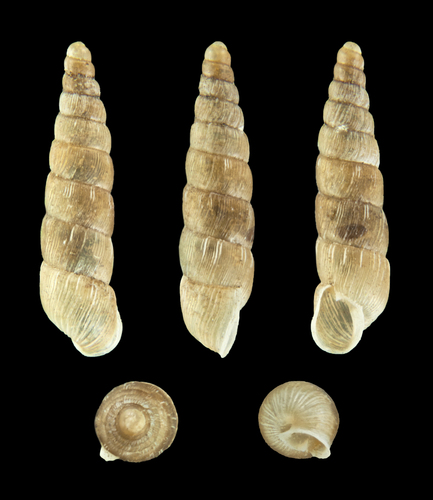
Balea perversa (Linnaeus, 1758) is a small snail species whose shell resembles that of a juvenile clausilid. The shell is pale brownish in color, often has a silky shiny surface, and typically bears distinct riblets. The apical whorls are cylindrical, and the shell has a total of 8 to 9 whorls. Unlike many clausiliids, the last whorl of the shell has the largest diameter. The shell is densely ribbed, and the cervix is almost entirely without a keel. There are no folds in the aperture apart from a rudimentary parietal fold, and this species does not have a clausilium. The shell measures 2.5–2.7 mm in width and 7–10 mm in height.
Balea perversa can be distinguished from Balea sarsii by its less slender shape and brownish (rather than yellowish) shell. The first whorl of Balea perversa increases in diameter less rapidly, and its shell sculpture is more prominently striated, usually with distinct riblets instead of coarse growth lines.
Balea perversa is widely distributed across western and central Europe, extending east to Ukraine and westernmost Russia. It is found in the British Isles (Great Britain and Ireland), Western Europe, Switzerland, Portugal, Germany (where it is classified as vulnerable nationally, and endangered in Bavaria), Austria (where it is vulnerable), the Czech Republic, Slovakia, an islet near Estonia, Sicily, Sardinia, and Iceland. In Scandinavia, it only occurs in coastal areas north of 62° N. While it has been reported from Crimea, these records are likely of Mentissa gracilicosta rather than this species.
In terms of ecology, Balea perversa lives on mosses and tree bark, and can also be found near roads, on walls, rocky slopes, and rocks; it occurs less commonly in ground litter. It is often found on surfaces encrusted with lichens and other epiphytes, and prefers trees with rough bark. In Portugal, it favors shady habitats, and it can tolerate non-calcareous soils. In Bulgaria, it occurs at elevations up to 1,600 m, and possibly as high as 2,400 m; in Switzerland, it is found up to 2,000 m. This species is easily dispersed by birds.
It feeds on mosses, algae, lichens, and cyanobacteria, and is known to selectively graze on various rock-dwelling lichens, particularly the crustose lichen Verrucaria nigrescens. Balea perversa is ovoviviparous, and self-fertilization is the dominant reproductive mode, even when individuals are kept in pairs in laboratory conditions. Under favorable conditions, individuals can reach maturity in 3 to 4 months, and a single adult can give birth to 10 to 20 juveniles per year. Balea perversa can remain active during mild winters.
Locally, this species is threatened by overly thorough and frequent restorations of old buildings, acid rain, air pollution, and the felling of old trees. It has largely disappeared from the interiors of cities. It remains frequent in Ireland, but many of its lowland colonies in England have been lost, and it has been extinct around London since the 1920s.