About Balea heydeni Maltzan, 1881
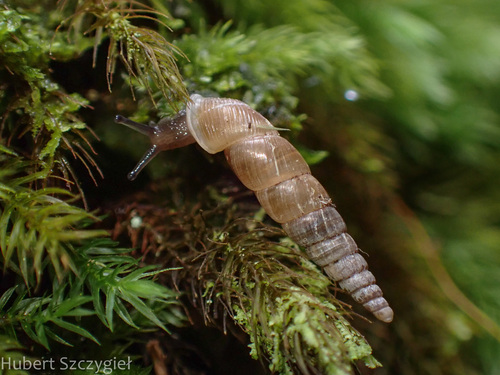
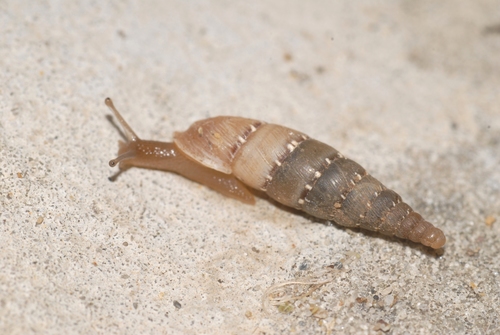
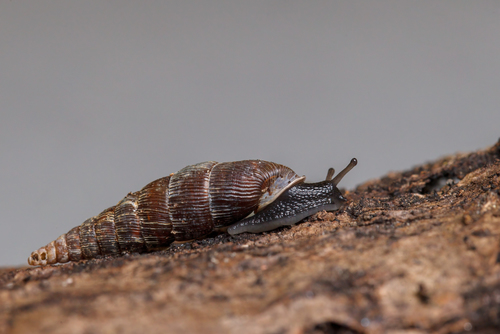
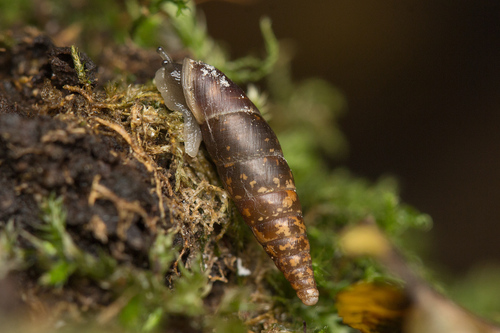
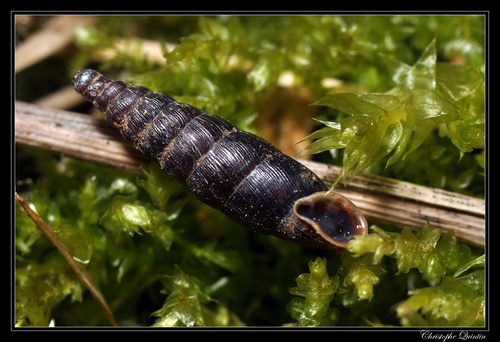
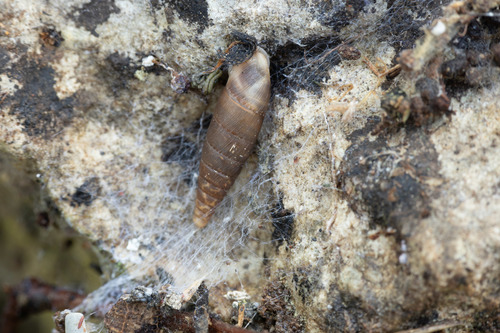
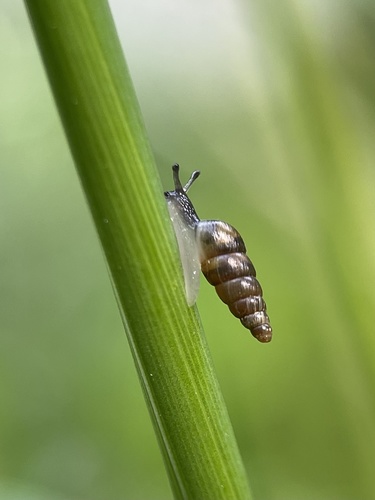
Like most other species in the family Clausiliidae, shells of Balea species are sinistral (left-handed) in coiling, and are much taller than they are wide. At first glance, adult Balea sarsii (if this species is classified under the name Balea heydeni Maltzan, 1881) look like juveniles of other clausiliid species, because this species lacks the prominent apertural structures that typically develop in adult clausiliids. The most reliable difference between B. sarsii and B. perversa is that the first whorls of B. sarsii increase in diameter more rapidly, giving the shell a conical appearance, while these whorls in B. perversa are more cylindrical. The shell of B. sarsii is broader, and yellowish rather than the darker brownish color seen in B. perversa. The surface sculpture of the B. sarsii shell has wrinkled, coarse growth lines, instead of the finer, more regular riblets found on B. perversa shells. A weak parietal denticle may be present in B. perversa, but it is never present in B. sarsii.
This species has an Atlantic distribution, and is known to occur in mainland Portugal and the Portuguese Atlantic Islands, the northwestern and northern coastal regions of Spain, coastal parts of France, coastal parts of Belgium, coastal parts of the Netherlands, Great Britain, Ireland, one coastal site at Møns Klint in Denmark, the west coast of Sweden, and Hordaland County and Sogn og Fjordane County in Norway. In Britain and Ireland, it is the more common of the two Balea species, and it also occurs inland here. A 2010 revision of Balea material from Sweden and Norway found two localities for B. sarsii on the Swedish west coast: the Island of Vinga outside Göteborg, and the island Storön in the archipelago of Väderöarna in the province of Bohuslän. The species is known from six Norwegian localities, five of which are in Hordaland County. It is considered very rare in Norway, as only sixteen Norwegian specimens have been found, among thousands of B. perversa.
The type locality of B. sarsii has been inferred to be Florø in Sogn og Fjordane County, which was the former home of M. Sars, who provided the specimens used for the species description. However, Sars had left Florø seven years before Pfeiffer published the description, and the original publication explicitly lists only Norway as the locality. Florø is the northernmost known locality of B. sarsii. If this species is correctly named Balea heydeni, its type locality is Sintra in Portugal, following the designation of a lectotype from that locality.
Balea sarsii sometimes co-occurs with B. perversa. These syntopic occurrences are not uncommon across many parts of the species' distribution area, and the two species likely have very similar ecologies. Balea species are rarely found on the ground; instead, they live on tree trunks and rocks, and are typically found in bark crevices. They eat lichens, and as a consequence, air pollution appears to have caused a reduction of the species' range in Britain.