About Balanus trigonus Darwin, 1854
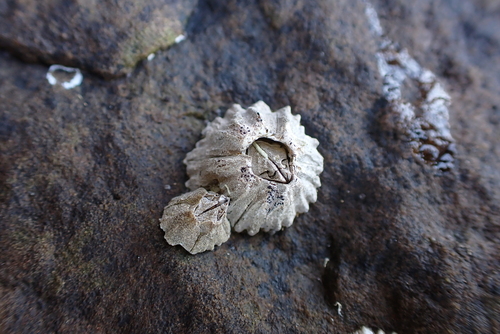
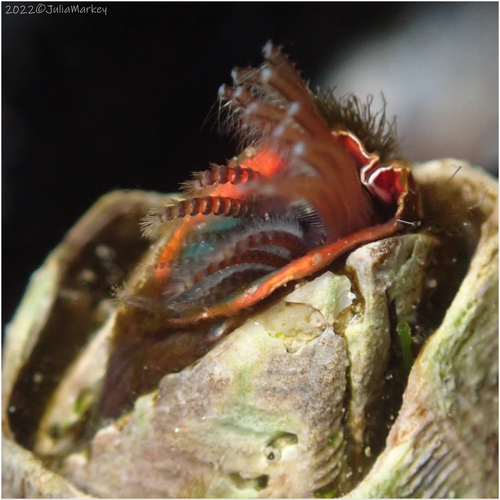
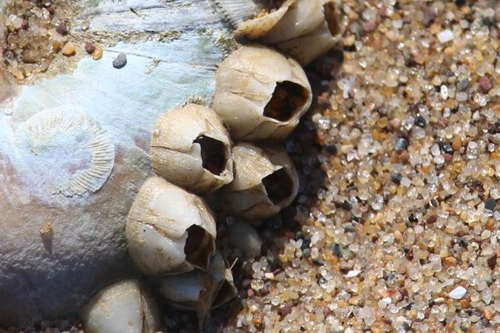
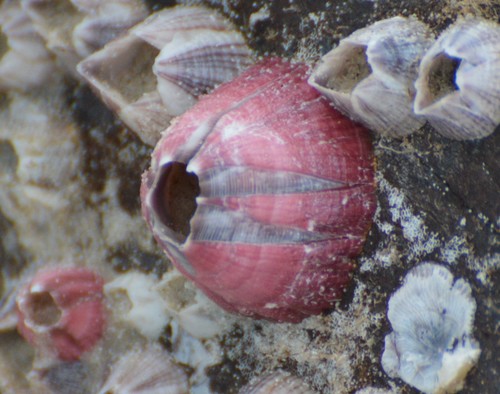
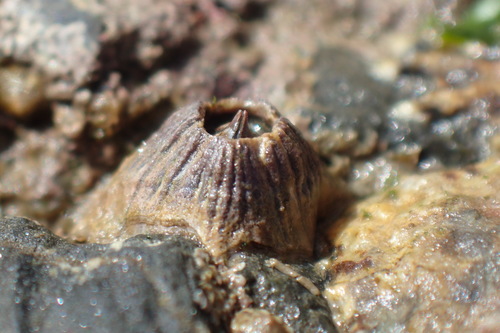
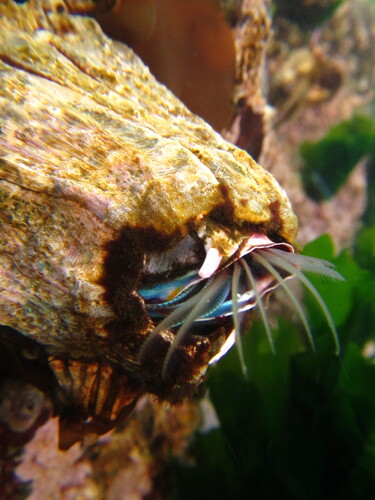
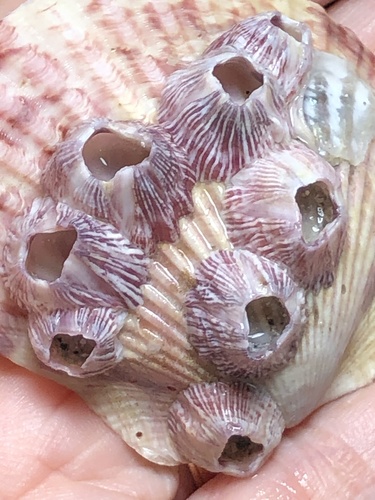
Balanus trigonus, commonly known as the triangle barnacle, is a species of barnacle in the family Balanidae. Individuals are steep-sided, conical, have six shell plates, and are dark pink in color. The species was first formally described by Charles Darwin in 1854, who placed it in the genus Balanus. Triangle barnacles were originally native only to the Indo-Pacific region and along the eastern Pacific coast, and were likely introduced to the Atlantic Ocean via human activity in the 19th century; the species now has a global, cosmopolitan distribution. In his original 1854 description, Darwin noted the species was 'widely distributed and where found seems to be common', and recorded its range as including New Zealand, Sydney, the island of Java, the East Indian Archipelago, Peru, California, and what he referred to as 'West Columbia'. Additional native ranges include waters around Korea and southern Japan, while its presence in the northern Sea of Japan is likely the result of human activity. The species is also found in the Persian Gulf, adjacent Gulf of Oman, waters around the Indian subcontinent, and along the east coast of Africa. All records of triangle barnacles in the Atlantic Ocean represent introduced populations, a fact that was not originally accepted. The mitochondrial genome of B. trigonus has been sequenced twice, producing slightly different results that have left the species' phylogenetic position unresolved. Tentative identification of B. trigonus fossils from Javan deposits dating to the Tertiary period was published in a 19th-century report from the HMS Challenger voyage. The species has been reported from late Cenozoic deposits, but these occurrences may not be valid. It has also been reported (without formal description) from Miocene deposits, and from Pliocene deposits, but both these reports are likely based on misidentifications. Undocumented reports exist of B. trigonus from Miocene deposits in Cuba and Pliocene deposits in Florida. Valid fossils of the species date to the Pleistocene, or possibly the Holocene, and B. trigonus is abundantly found in Pleistocene fossil records from parts of the east Pacific coast. All triangle barnacles are sessile as adults, and attach to hard substrates including rocks, shells, wood, and ship hulls. They may also attach to living crustaceans, corals, and sea urchins; one recorded Panulirus gracilis lobster had at least 1019 attached cypris larvae and 1746 encrusted adult B. trigonus on its body. Triangle barnacles usually occupy subtidal habitats below the water surface. They have been recorded as deep as 450 metres (1,480 ft), with one record from 3,000 metres (9,800 ft). The species is commonly classified as a fouling organism that colonizes ships and dock infrastructure. In regions where it is invasive, B. trigonus may compete with native barnacle species for available habitat. Like all barnacles, B. trigonus has a motile larval stage: first the free-swimming nauplius, then the non-feeding cyprid larva that attaches to a substrate before metamorphosing into a sessile adult. Adult B. trigonus reproduce year-round, and individuals as young as one month old are capable of reproduction. A single individual can produce multiple broods in a single year.