About Balanophora fungosa J.R.Forst. & G.Forst.
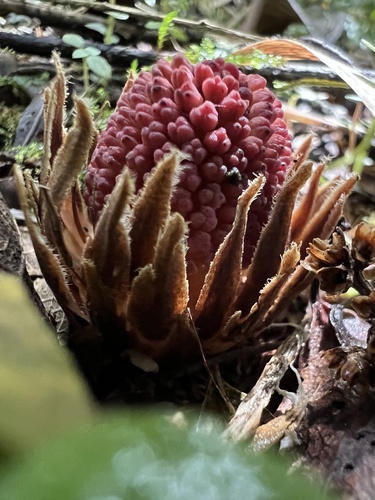
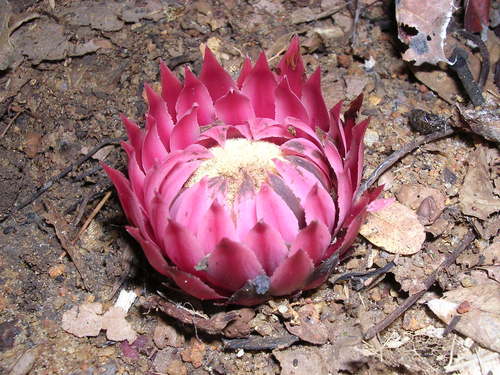
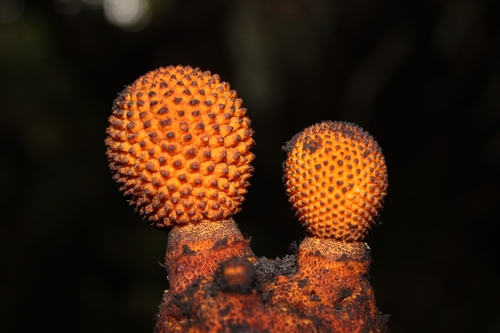
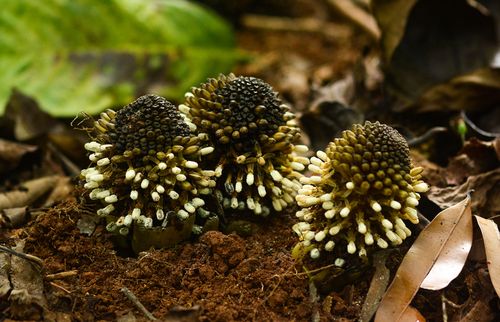
Like other species in the genus Balanophora, Balanophora fungosa J.R.Forst. & G.Forst. is a holoparasitic plant that contains no chlorophyll. Its above-ground aerial parts develop from a hard, irregularly shaped tuber, which produces the plant's flower-bearing structures. The leaves of B. fungosa are scale-like, pale cream in color, 8–30 millimetres (0.3–1 in) long, 7–20 millimetres (0.3–0.8 in) wide, and more or less clasp around the stem. This species can be either monoecious or dioecious. When monoecious, it produces both pistillate (female) and staminate (male) flowers. Thousands of tiny female flowers cover a globe-shaped structure 15–20 millimetres (0.6–0.8 in) in diameter, with styles less than 1 millimetre (0.04 in) long. Around 20 male flowers grow arranged around the base of the globe, each 3–5 millimetres (0.1–0.2 in) in diameter with a stalk (pedicel) 5–6 millimetres (0.20–0.24 in) long, and covered in powdery white pollen. Balanophora fungosa grows in coastal habitats from near sea level up to 900 metres (3,000 ft), and is distributed across Australia, Taiwan, Indonesia, the Ryukyu Islands, New Guinea, the Philippines, several Pacific Islands including New Caledonia, India, and Cambodia. In Australia, it is found in Queensland, ranging from around Noosa to the tip of Cape York Peninsula. Twelve plant species from eight families are known to act as hosts for Balanophora fungosa var. indica, including species in the genera Syzygium, Olea, and Rapanea. This plant sometimes grows as a weed in coffee and tea plantations. Many small animals visit B. fungosa flowers, including ants, springtails, flies, a noctuid moth, and even rats, which seem to be attracted by the plant's scent. Worker Asiatic honeybees (Apis cerana) have been observed collecting pollen from B. fungosa. Two beetle species in the genus Lasiodactylus, a pyralid moth, and a tipulid moth use the bracts at the base of the plant's flowers as a breeding site. Some cultures, such as the Paliar people of Tamil Nadu, use B. fungosa to treat medical conditions.