About Balaenoptera physalus (Linnaeus, 1758)
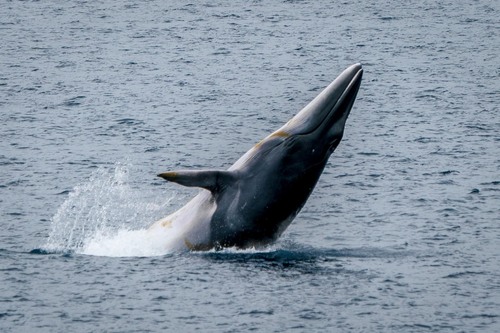
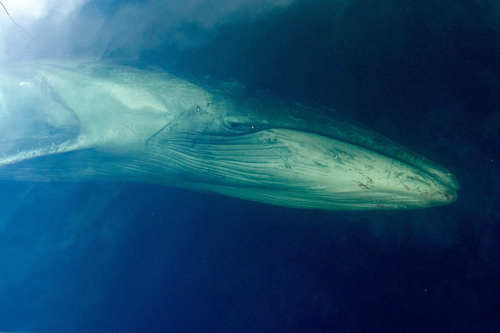
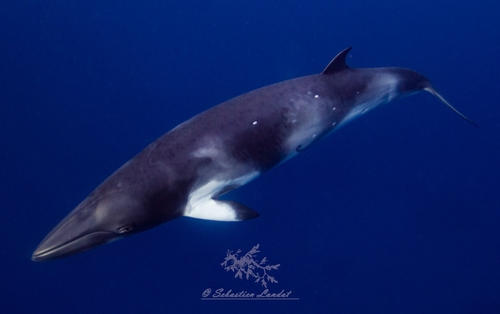
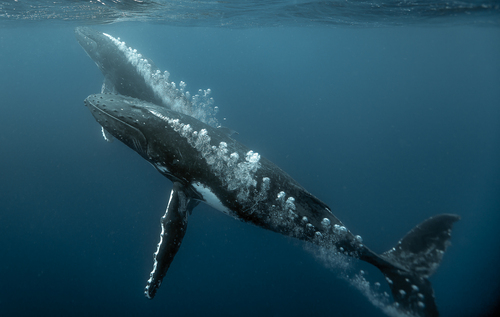
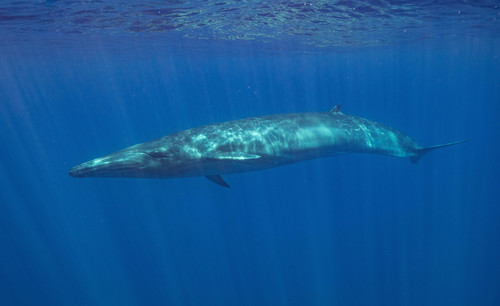
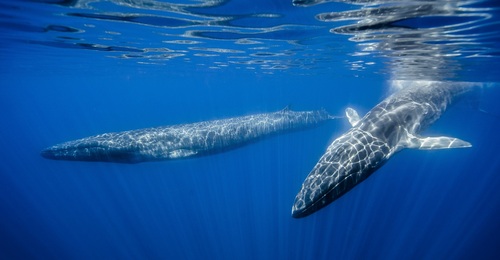
The fin whale (scientific name Balaenoptera physalus (Linnaeus, 1758)), also called the finback whale or common rorqual, is a species of baleen whale, and the second-longest cetacean on Earth after the blue whale. The largest reported individual measured 26–27 m (85–89 ft) in length, with a maximum recorded weight of 65.5 to 120 tonnes (72.2 to 132.3 short tons; 64.5 to 118.1 long tons). Fin whales have long, slender bodies that are brownish-gray in color, with a paler underside that creates countershading, making the animal less conspicuous when viewed from below. At least two recognized subspecies exist: one found in the North Atlantic, and another distributed across the Southern Hemisphere. Fin whales live in all major oceans, ranging from polar to tropical waters. They are only absent from waters close to polar pack ice, and relatively small bodies of water located away from the open ocean. Their highest population density occurs in temperate and cool waters. Their diet consists mainly of smaller schooling fish, small squid, and crustaceans, including copepods and krill. Fin whales mate in temperate, low-latitude seas during the winter. They are most often seen in groups (pods) of 6–10 individuals, and communicate using frequency-modulated sounds that range from 16 to 40 hertz. Like all other large whales, the fin whale was a highly sought-after target during the peak of the whaling industry, from 1840 to 1861. It remained a common target well into the 20th century, and decades of overharvesting caused fin whale populations to decline through the late 20th century. Between 1905 and 1976, over 725,000 fin whales were reportedly hunted and removed from the Southern Hemisphere. Even by 2100, the recovered population size of the southern fin whale subspecies is predicted to be less than 50% of its pre-whaling size, due to the long-lasting impacts of historical whaling and the species' slow population recovery rate. As of 2018, the fin whale has been assessed as vulnerable on the IUCN Red List.
Like many large rorquals, the fin whale is a cosmopolitan species. It inhabits all of the world's major oceans, in waters ranging from polar to tropical regions. It is only absent from waters close to the polar ice pack at both the northern and southern extremes of its range, and from relatively small bodies of water far from large open oceans, such as the Red Sea. Fin whales can however reach the Baltic Sea, a marginal sea that meets their habitat requirements. Their highest population density occurs in temperate and cool waters, and they are less densely distributed in the warmest, equatorial regions.
The North Atlantic fin whale has an extensive range, occurring from the Gulf of Mexico and Mediterranean Sea northward to Baffin Bay and Spitsbergen. In general, fin whales are more common north of approximately 30°N latitude; considerable confusion exists around their occurrence south of 30°N latitude, because it is difficult to distinguish fin whales from Bryde's whales. Extensive ship surveys have led researchers to conclude that the summer feeding range of fin whales in the western North Atlantic lies mainly between 41°20'N and 51°00'N, extending from the shore seaward to the 1,000 fathoms (6,000 ft; 1,800 m) depth contour.
In the North Pacific, fin whales' summer distribution covers the immediate offshore waters from central Baja California to Japan, and extends as far north as the Chukchi Sea that borders the Arctic Ocean. They occur in high densities in the northern Gulf of Alaska and southeastern Bering Sea between May and October, with some movement through the Aleutian passes into and out of the Bering Sea. Several whales tagged between November and January off southern California were killed during the summer off central California, Oregon, British Columbia, and in the Gulf of Alaska. Fin whales have been observed feeding 250 miles south of Hawaii in mid-May, and several winter sightings of the species have been recorded there. Some researchers have suggested that fin whales primarily migrate into Hawaiian waters during autumn and winter.
Although fin whales are confirmed to be migratory, moving seasonally into and out of high-latitude feeding areas, their overall migration pattern is not well understood. Acoustic data from passive-listening hydrophone arrays shows that North Atlantic fin whales migrate southward in autumn from the Labrador-Newfoundland region, moving south past Bermuda and into the West Indies. Researchers think that one or more fin whale populations stay in high latitudes year-round, moving offshore but not traveling south in late autumn. A study based on resighting of identified individual fin whales in Massachusetts Bay found that calves often learn migratory routes from their mothers, and return to their mother's feeding area in later years. In the Pacific, migration patterns are still poorly characterized. While some fin whales appear to be present year-round in the Gulf of California, their numbers increase significantly there during winter and spring. Southern fin whales migrate seasonally: they travel from relatively high-latitude Antarctic feeding grounds in the summer to low-latitude breeding and calving areas in the winter. The exact location of their winter breeding areas remains unknown, because these whales typically migrate through the open ocean.
Research has found that populations of fin whales living in the Mediterranean have preferred feeding locations that partially overlap with areas of high plastic pollution and microplastic debris. This overlap is most likely because both microplastics and the fin whales' food sources are concentrated near high trophic upwelling areas.
Before commercial whaling began, the total historical fin whale population in the North Pacific was estimated to be 42,000 to 45,000 individuals. Of this total, the population living in the eastern portion of the North Pacific was estimated at 25,000 to 27,000. Surveys carried out in 1991, 1993, 1996, and 2001 produced population estimates between 1,600 and 3,200 off California, and between 280 and 380 off Oregon and Washington. Surveys conducted in coastal waters of British Columbia during the summers of 2004 and 2005 estimated an abundance of approximately 500 animals. Fin whales may have begun returning to coastal waters off British Columbia (a sighting was recorded in Johnstone Strait in 2011) and Kodiak Island. The size of the local population that migrates to the Hawaiian Archipelago is unknown.
Finbacks are also relatively abundant along the coasts of Peru and Chile. In Chile, they are most commonly found off the Los Lagos region, including the Gulf of Corcovado in Chiloé National Park, Punta de Choros, the port of Mejillones, and Caleta Zorra. Year-round confirmed sightings indicate there may be resident fin whales off pelagic northeastern to central Chile, in areas around coastal Caleta Chañaral and Pingüino de Humboldt National Reserve, east of the Juan Fernández Islands, and northeast of Easter Island. There may also be a wintering ground for the eastern South Pacific fin whale population in this region. Sightings and older records of fin whales exist in the Northern Indian Ocean and Bay of Bengal, including areas along the coasts of Sri Lanka, India, and Malaysia.