About Balaenoptera musculus (Linnaeus, 1758)
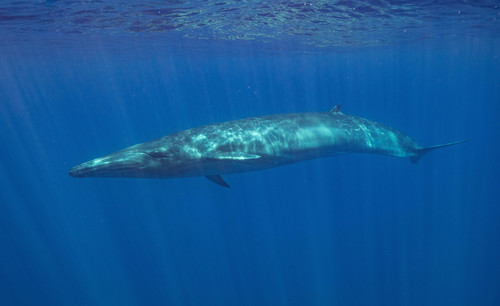
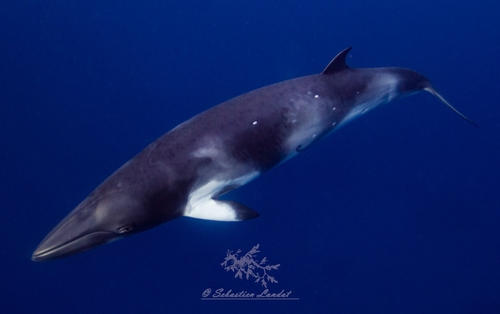
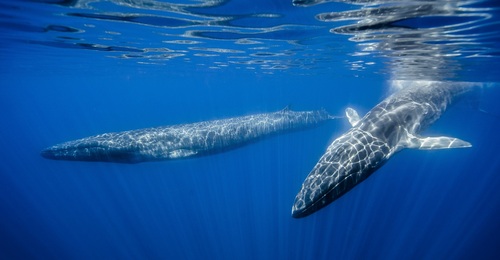
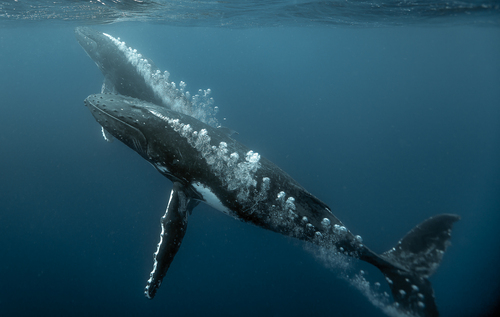
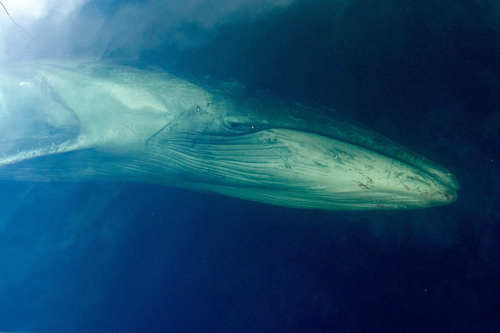
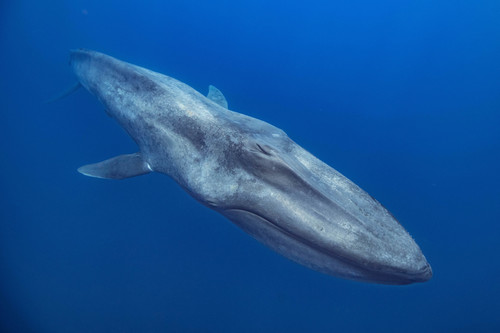
The blue whale, Balaenoptera musculus (Linnaeus, 1758), is a slender-bodied cetacean. It has a broad U-shaped head, thin elongated flippers, a small sickle-shaped dorsal fin positioned close to the tail, and a large tail stock at the root of its wide, thin flukes. The upper jaw holds 70–395 black baleen plates, and 60–88 grooves run across the throat region, allowing the skin to expand during feeding. Blue whales have two blowholes that can produce a spout reaching 9.1–12.2 meters (30–40 ft) into the air. Their skin has mottled grayish-blue coloration that appears blue when underwater, and mottling patterns near the dorsal fin vary between individual whales. The underbelly has lighter pigmentation, and can look yellowish when colonized by waterborne diatoms; this trait historically gave the species the nickname "sulphur bottom".
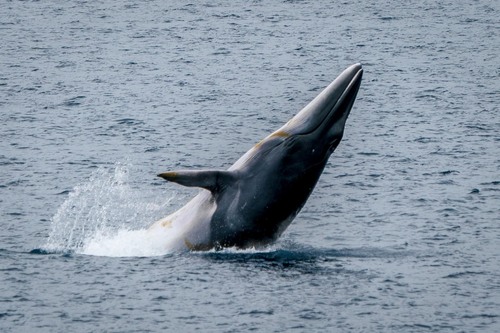
Blue whales are most often solitary, though they may occur in pairs. When local food productivity is high, blue whales can gather in groups of more than 50 individuals. Most populations undertake long migrations: they travel to polar summer feeding grounds, then move to more equatorial winter breeding grounds. Blue whales appear to use memory to find the best feeding locations. There is evidence of alternative movement strategies, including year-round residency in an area, partial migration where only some individuals in a population migrate, and age- or sex-based migration. Some blue whales have even been recorded feeding while on their breeding grounds. Blue whales typically swim at 2–8 kilometers per hour (1.2–5.0 mph), but can swim much faster, reaching 32–48 kilometers per hour (20–30 mph), when interacting with boats, predators, or other blue whales. Their very large size limits their ability to leap fully out of the water. The deepest dive recorded from a tagged blue whale was 315 meters (1,033 ft). The species has an estimated theoretical aerobic dive limit of 31.2 minutes, though the longest dive actually measured was only 15.2 minutes. The deepest confirmed dive from a pygmy blue whale, a subspecies of blue whale, reached 506 meters (1,660 ft). A blue whale's heart rate can drop as low as 2 beats per minute (bpm) at deep depths, but rises to 37 bpm when the whale surfaces, which is near its maximum peak heart rate.
Blue whales reach sexual maturity between 5 and 15 years of age overall: females reach sexual maturity at an average of 10 years, while males reach it at an average of 12 years. In the Northern Hemisphere, females reach maturity at a body length of 21–23 meters (69–75 ft), and males reach maturity at 20–21 meters (66–69 ft). In the Southern Hemisphere, mature females reach 23–24 meters (75–79 ft) at maturity, while mature males reach 22 meters (72 ft) on average. Male pygmy blue whales average 18.7 meters (61.4 ft) long at sexual maturity. Female pygmy blue whales are 21.0–21.7 meters (68.9–71.2 ft) long and roughly 10 years old when they reach sexual maturity. Because a new corpus is added in the ovary roughly every 2.5 years after sexual maturity, blue whales are thought to reach full physical maturity at 35 years old. Very little is known about blue whale mating behavior, or specific breeding and birthing locations. Blue whales appear to be polygynous, with males competing for access to females. A male blue whale usually trails a receptive female and fights off any competing rival males. Mating occurs from fall through winter. Pregnant females eat roughly four percent of their total body weight each day, accumulating 60% of their overall body weight over the summer foraging period.
Gestation lasts 10–12 months. Newborn calves measure 6–7 meters (20–23 ft) long and weigh 2–3 metric tons (2.0–3.0 long tons; 2.2–3.3 short tons) at birth. Because blue whale calves require 2–4 kilograms (4.4–8.8 lb) of milk per kilogram of mass gained, females are estimated to produce around 220 kilograms (490 lb) of milk per day, with a daily range of 110 to 320 kilograms (240 to 710 lb). The first video of a supposedly nursing blue whale calf was filmed in New Zealand in 2016. Calves are weaned when they are 6–8 months old and reach a length of around 16 meters (53 ft). A newborn blue whale calf gains approximately 90 kilograms (200 lb) per day, and gains roughly 17,000 kg (37,500 pounds) total during the weaning period. The time between successive births for female blue whales is two to three years, and averages 2.6 years for pygmy blue whales. Mother-calf pairs are only rarely observed, which may be because mothers give birth and wean their young during the interval between when they leave and return to their summer feeding grounds.