About Balaenoptera bonaerensis Burmeister, 1867
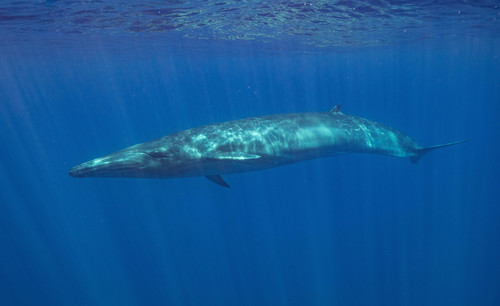
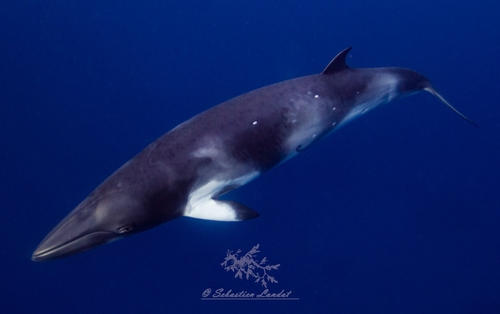
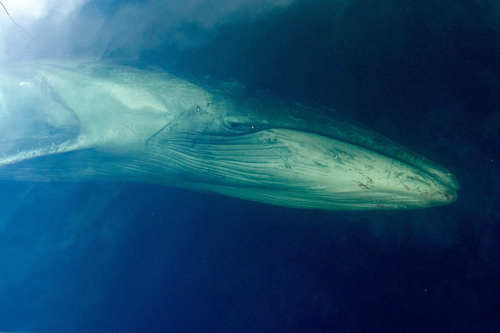
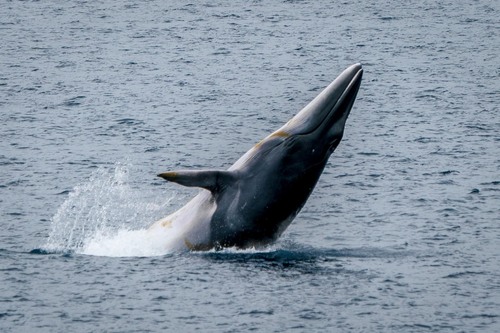
The Antarctic minke whale, also called the southern minke whale, has the scientific name Balaenoptera bonaerensis. It is a minke whale species belonging to the baleen whale suborder. It is the second smallest rorqual, only larger than the common minke whale, and the third smallest baleen whale overall. Though it was first scientifically described in the mid-19th century, it was not accepted as a distinct species until the 1990s. The whaling industry once ignored this species due to its small size and low oil yield, which allowed it to avoid the decline that affected other baleen whale species. It maintained a large population numbering in the hundreds of thousands into the 21st century. It has survived to become the most abundant baleen whale in the world, and today it is one of the main species targeted by the whaling industry, alongside its widespread counterpart the common minke whale. Antarctic minke whales are primarily found only in the Southern Hemisphere, though vagrant individual whales have been reported in the North Atlantic. Their main food source is euphausiids. Antarctic minke whales are found across most of the Southern Hemisphere, and some individuals even cross the equator into the Northern Hemisphere. In the western South Atlantic, they have been recorded off Brazil from 0°53'N to 27°35'S nearly year-round, off Uruguay, off central Patagonia in Argentina from November to December, and in the Strait of Magellan and Beagle Channel of southern Chile from February to March. In the eastern South Atlantic, they have been recorded in the Gulf of Guinea off Togo, off Angola, off Namibia in February, and off Cape Province, South Africa. In the Indian and Pacific Oceans, they have been recorded off Natal Province, South Africa, off Réunion in July, off Australia from July to August, off New Zealand, off New Caledonia in June, off Ecuador at 2°S in October, off Peru at 12°30'S from September to October, and in the northern fjords of southern Chile. Confirmed vagrants outside their main range include an 8.2 metre (26.9 foot) female killed 45 km (28 mi) upstream the Coppename River in Suriname in October 1963, a 7.7 metre (25.3 foot) female found dead off Louisiana, a US state, in the Gulf of Mexico in February 2013, and a vagrant recorded off Jan Mayen in the northeastern North Atlantic in June. During the breeding season, Antarctic minke whales disperse into offshore waters. In spring (October to December), Japanese sighting surveys conducted between 1976 and 1987 recorded relatively high encounter rates of minke whales off South Africa and Mozambique between 20° – 30°S and 30° – 40°E, off Western Australia between 20° – 30°S and 110° – 120°E, around the Gambier Islands of French Polynesia between 20° – 30°S and 130° – 140°W, and in the eastern South Pacific between 10° – 20°S and 110° – 120°W. Later surveys that could distinguish between Antarctic minke whales and dwarf minke whales confirmed that most of the sightings from these surveys were Antarctic minke whales. Antarctic minke whales have a circumpolar distribution in the Southern Ocean, where they have been recorded year-round, including in the Bellingshausen, Scotia, Weddell and Ross Seas. They are most abundant in the MacKenzie Bay-Prydz Bay area between 60° – 80°E, south of 66°S. They are also relatively numerous off Queen Maud Land between 0° – 20°E and 66° – 70°S, in the Davis Sea between 80° – 100°E, south of 66°S, in the Ross Sea between 160°E – 140°W, south of 70°S, and in the southern Weddell Sea between 20° – 40°W, south of 70°S. Like their larger relative the blue whale, Antarctic minke whales have a specific preference for pack ice. In spring (October to November), they are found widely throughout the pack ice zone, all the way to near the edge of the fast ice. In this area, they have been observed between belts of pack ice and in leads and polynyas, often in heavy ice cover. Some individuals have become trapped in ice and forced to overwinter in Antarctica. One documented example occurred in August 1955 in Prince Gustav Channel, east of the Antarctic Peninsula and west of James Ross Island, where up to 120 "lesser rorquals" were trapped in a small breathing hole alongside sixty killer whales and an Arnoux's beaked whale.