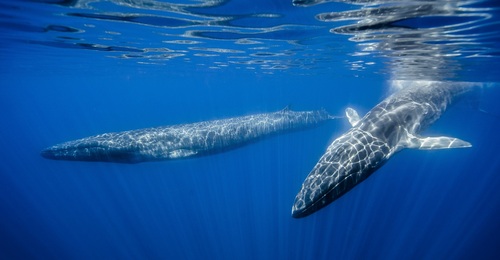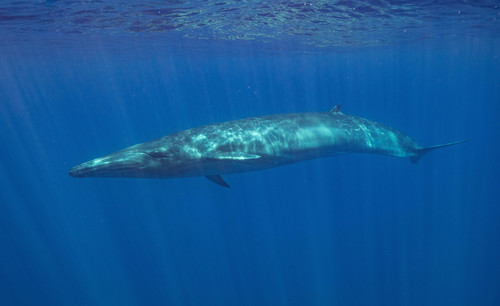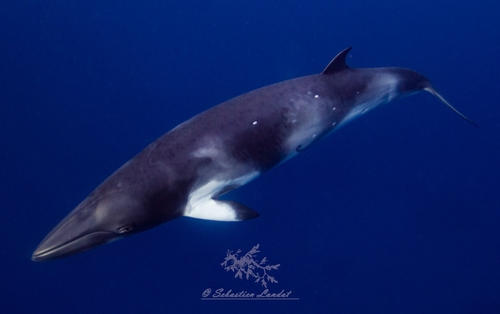
About Balaenoptera acutorostrata Lacépède, 1804
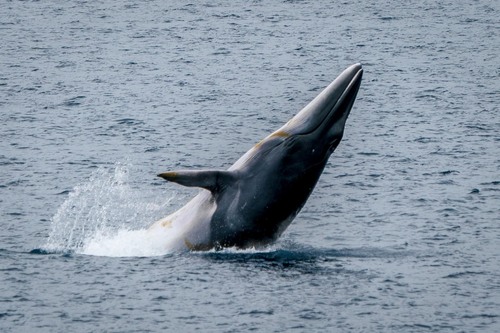
The common minke whale, also called the northern minke whale (scientific name Balaenoptera acutorostrata Lacépède, 1804), is a minke whale species that belongs to the baleen whale suborder. It is the smallest rorqual species, and the second smallest baleen whale species. Initially, whalers ignored this species due to its small size and low oil yield, but various countries began exploiting it starting in the early 20th century. As other whale species declined, larger numbers of common minke whales were caught, primarily for their meat. Today, it is one of the main targets of the whaling industry. A dwarf form of this species exists in the Southern Hemisphere. Fossil remains of this species date from the Pliocene epoch to the current Quaternary period, with an age range spanning 4.7 million years ago to the present. Around 209,800 common minke whales exist worldwide. They have a disjointed distribution. In the North Atlantic, they range as far north as Baffin Bay, Svalbard, Franz Josef Land, and Novaya Zemlya, and as far south as 40°N (New Jersey), the Hebrides, and the central North Sea during the summer. There are a handful of records from Hudson Bay (a 1986 sighting in James Bay and a 1990 sighting in Button Bay), and they are occasionally observed in Hudson Strait and Ungava Bay. They have been recorded off Madeira, and occur year-round off the Canary Islands. Occasional sightings and strandings have been reported off Spain and Portugal, western Sahara, Mauritania, and Senegal. They are rare off the Azores, are vagrants in the Gulf of Mexico and the Mediterranean Sea, and have a few recorded sightings from the Black Sea (in 1880 and 1926). During winter, they have been recorded off Bermuda, the Bahamas, the Antilles, the east coast of the United States south of 40°N, and in the southeastern North Atlantic between 10°40'N and 19°35'N, and 22°W and 20°05'W. In the western and central North Pacific, they range from Hawaii, the Mariana Islands, the East China Sea, the Yellow Sea, and the Sea of Japan in the south, to the Sea of Okhotsk, and the Bering and Chukchi Seas in the north. In the eastern North Pacific, they occur from the Gulf of Alaska south along the entire west coast of North America (covering the U.S. states of Alaska, Washington, Oregon, and California, and the Canadian province of British Columbia), extending down to Baja California and into the Gulf of California. During winter, acoustic recordings show they are mostly found between 15° and 35°N in the eastern and central North Pacific. The dwarf form has been recorded off Brazil (from June to February, across the states of Maranhão, Paraíba, Bahía, Espírito Santo, Rio de Janeiro, São Paulo, Paraná, Santa Catarina, and Rio Grande do Sol) between 2°44'S to 33°35'S, as well as in Uruguay, Argentina, the Beagle Channel and Goree Passage of southern Chile (from February to April), off South Africa (from May to August), Australia (from March to December, across Western Australia, Victoria, New South Wales, and Queensland), New Zealand (from March to August), New Caledonia, Vanuatu, Fiji, and as far south as the South Shetland Islands, Gerlache Strait, and the Bellingshausen Sea at 69°25'S. Female common minke whales reach sexual maturity at around 6 to 8 years of age, while males reach sexual maturity at around 6 to 7 years of age. Females are promiscuous. After a 10-month gestation period, a single 2.6 m (8.5 ft) calf is born; only one out of 79 mature females in a study of minke whales off Iceland carried twin fetuses: an 8.7 m (29 ft) female caught in July 2006 that carried a 34 cm (13 in) male fetus and a 32 cm (13 in) female fetus. Calves are weaned after six months. Peak conception occurs in February in the North Atlantic, from late February to mid-March for the "O stock" that migrates along Japan's eastern coast to the Okhotsk Sea, and between October and November for the "J stock" that lives in the Yellow Sea, East China Sea, and Sea of Japan, and migrates to the southern Okhotsk Sea in spring, where it mixes with O stock. Peak calving occurs in December in the North Atlantic, from December to January in the North Pacific, and from May to July for J stock. The calving interval is just one year, so females are often pregnant and lactating at the same time. Females may reach physical maturity as early as 13 years of age; another study found growth stops for both sexes when they have 15 to 20 growth layers in their tympanic bullae, which corresponds to roughly 15 to 20 years of age. Both sexes can live up to around 50 years; in a study of Icelandic minke whales, the oldest recorded individual was 42 years for a female and 47 years for a male.