About Balaena mysticetus Linnaeus, 1758
Scientific name: Balaena mysticetus Linnaeus, 1758
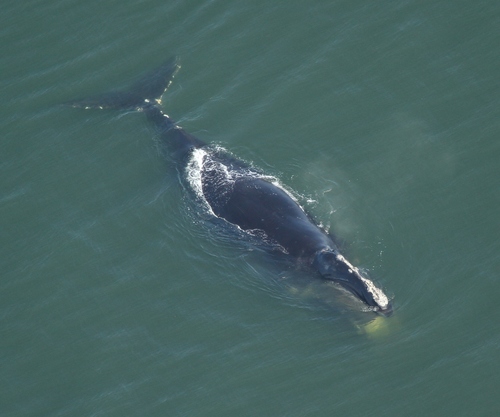
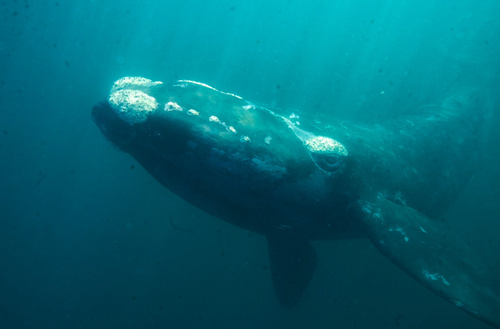
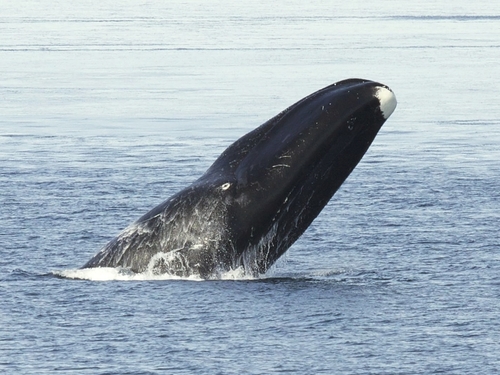
Description The bowhead whale is among the largest baleen whale species. It has a round body, an exceptionally curved rostrum, a large head, and long, dark baleen plates. Relative to its body size, the bowhead whale has the largest head of any cetacean, reaching nearly 40% of its total body length. Two blowholes sit atop its head, and can propel a water stream up to 6.1 m (20 ft) into the air. Its lower lips surround the baleen racks, and appear as a curved circle when viewed from the side. It also has wide, triangular flukes, and fairly large, oar-shaped flippers. Most of its skin is black, with white patches around its flukes, tail, eyes, and chin. All of these patches develop over the whale’s lifetime, except the chin patch, which is usually visible on newborn calves and grows at the same rate as the whale’s overall body size.
Adult bowhead whales usually reach 14 to 18 m (46 to 59 ft) in length, with a maximum weight of 75 to 100 t (74 to 98 long tons; 83 to 110 short tons). The species’ fluke measures 2–6 m (6 ft 7 in – 19 ft 8 in) across, and individuals have 230 to 360 baleen plates. Recorded baleen plate lengths range from a minimum of 2.97 m (9 ft 9 in) to a maximum recorded size of 4.27 m (14.0 ft); estimates place the maximum possible baleen length at 4.3–5.2 m (14 ft 1 in – 17 ft 1 in), which is over a meter longer than the baleen of any other whale. The bowhead whale’s tongue is 5 m (16 ft 5 in) long and 3.0 m (10 ft) wide.
This species is sexually dimorphic: females usually reach 16–18 m (52–59 ft) in length, while males average 14–16 m (46–52 ft). Some individual specimens exceed these size ranges. In the 1800s, a female killed near Pond Inlet was reportedly 19.8 m (65 ft) long. Some estimates place the maximum total length of the species as high as roughly 20 m (66 ft). The baleen plates of this large reported female measured 3.2 m (10 ft 6 in) long. Currently, the maximum reliable length for females is believed to be around 19 m (62 ft), while the maximum length for males is thought to be 16–17 m (52–56 ft). The longest bowhead whale measured via photographs was 17.57 m (57.6 ft).
Analysis of hundreds of DNA samples from living bowhead whales, and from baleen used in boats, toys, and housing materials, shows that Arctic bowhead whales have lost a significant portion of their genetic diversity over the past 500 years. Originally, bowheads crossed ice-covered inlets and straits to allow gene exchange between Atlantic and Pacific populations; this conclusion comes from analysis of maternal lineages using mitochondrial DNA. Whaling and climatic cooling during the Little Ice Age (from the 16th century to the 19th century) are thought to have reduced the whales’ summer habitats, which explains the observed loss of genetic diversity.
A 2013 discovery clarified the function of the bowhead’s large palatal retial organ. This bulbous ridge of highly vascularized tissue, called the corpus cavernosum maxillaris, extends along the center of the hard palate, forming two large lobes on the rostral palate. Histologically, this tissue is similar to the corpus cavernosum of the mammalian penis. This organ is thought to provide a cooling mechanism for the whale, which is normally insulated from cold Arctic waters by 40 cm (16 in) or more of fat. During physical exertion, the whale must cool itself to prevent hyperthermia and eventual brain damage. When the whale exerts itself, this organ becomes engorged with blood; as the whale opens its mouth, cold seawater flows over the organ to cool the blood passing through it.
In one study, brain masses were recorded from two males measuring 12 m (39 ft) and 13.3 m (44 ft) in total length, at 2.072 kg (4.57 lb) and 2.280 kg (5.03 lb) respectively. With a gyrencephalic index of 2.32, the brains of these two males showed extremely high gyrification. Compared to other cetaceans, bowhead whale brains have a lower level of gyrification in the cerebral cortex, more vertically aligned gyri, and a relatively dull temporal pole region.
A bowhead whale’s penis can reach up to 3.0 m (10 ft) in length. In adults, testicles usually weigh less than 150 kg (330 lb), but one individual estimated to weigh around 54 t (53 long tons; 60 short tons) had testicles that weighed 211 kg (465 lb) and measured 1.5 m (4 ft 11 in) in length.
Beluga whales often travel alongside bowhead whales, out of curiosity and to access open breathing spots in polynyas, because bowheads can break through ice from underwater by headbutting. Bowhead whales can break through ice that is less than 20 cm (7.9 in) thick, and are even capable of breaking through ice up to 60 cm (24 in) thick. Bowhead whales use rocks to scrub dead skin cells off their bodies. They may interact with other cetacean species such as right whales and sei whales, and one specimen thought to be a hybrid between a bowhead whale and a right whale has been recorded.
Range and habitat The bowhead whale is the only baleen whale that spends its entire life in Arctic and subarctic waters. The Alaskan bowhead population spends winter in the southwestern Bering Sea. In spring, the group migrates north, following ice openings, into the Chukchi and Beaufort seas. The whale’s range changes based on climate shifts and the formation and melting of ice.
Historically, the bowhead whale’s range may have been broader and extended further south than it does today. Bowheads were common around Labrador, Newfoundland (Strait of Belle Isle), and the northern Gulf of St. Lawrence until at least the 16th and 17th centuries. It is unclear whether this southerly range was caused by colder climate during those periods. During the Pleistocene, the distribution of Balaena spp. extended much further south: fossils have been found in Italy and North Carolina, so their range at that time may have overlapped with the range of Eubalaena at those locations.
Reproduction Sexual activity occurs between pairs, and in active groups of several males and one or two females. The breeding season runs from March through August; conception is believed to happen primarily in March, when singing activity is at its peak. Sexual maturity is estimated to occur at 15–25 years of age, and physical maturity at 50–60 years. The gestation period is 13–14 months, and females produce one calf every three to four years. There is no evidence of reproductive aging in males, and one case of penile sperm discharge has been reported from a male bowhead whale estimated to be 159 years old. However, there is evidence of possible reproductive aging in female bowhead whales: individuals aged 133, 139, and 149 years suggest that females experience reproductive cessation or senescence. The oldest female captured carrying a fetus was estimated to be 121 years old. Lactation typically lasts around one year. Female bowheads may be capable of producing calves for up to 100 years. To survive in cold water immediately after birth, calves are born with a thick layer of blubber. Within 30 minutes of birth, bowhead calves can swim on their own. A newborn calf is typically 4–4.5 m (13–15 ft) long, weighs roughly 1,000 kg (2,200 lb), and grows to 8.2 m (27 ft) within its first year of life.