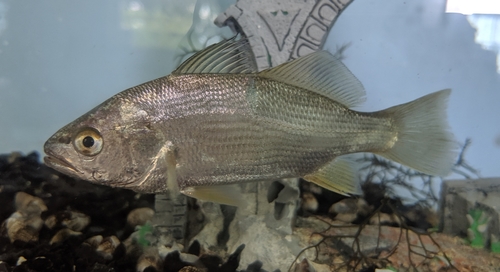
About Bairdiella chrysoura (Lacepède, 1802)
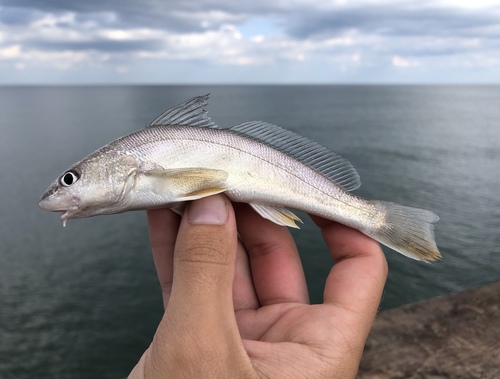
Bairdiella chrysoura has a moderately large, obliquely angled terminal mouth, with the lower jaw projecting further than the upper jaw. It does not have a barbel on the chin, but does have three pairs of mental pores; the arrangement of chin barbels and pores is used to distinguish between different species in the family Sciaenidae. The preopercle, the bony plate located just in front of the operculum, has a small number of angled spines. The dorsal fin of this species contains 10 to 11 spines and 19 to 23 soft rays. The anal fin has two spines and 8 to 10 soft rays; the second anal spine is sharp, and measures more than two-thirds the length of the first soft anal ray. This fish has a two-chambered swim bladder that connects to the inner ear, giving it hearing ability comparable to that of the goldfish, a species well-known for its good auditory sense. Its overall body coloration is silvery, with a greenish or bluish tint on the dorsal (upper) surface and a silvery or yellowish tint on the underside. The fins are yellowish or greyish in color. Silver perch, the common name for Bairdiella chrysoura, are similar in appearance to sand seatrout and silver seatrout, two closely related weakfish species. Unlike Bairdiella chrysoura, seatrout typically have 1 or 2 prominent canine teeth at the tip of the upper jaw and do not have chin pores. Bairdiella chrysoura is native to the east coast of North America, with a range that extends from New York in the north to Mexico in the south. It inhabits inshore environments, including seagrass beds, tidal creeks, rivers, and marshes.