About Baeometra uniflora (Jacq.) G.J.Lewis
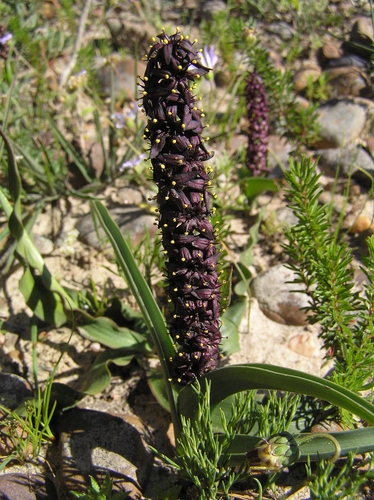
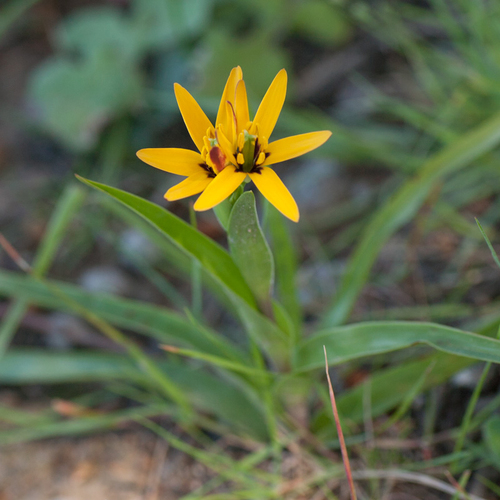
Beetle lily, Baeometra uniflora, is a geophyte that reaches up to 30 cm (12 in) in height. It produces five to eight lance-shaped leaves arranged in a spiral, which clasp the base of the stem. The largest leaf grows 10–30 cm (3.9–11.8 in) long, while the uppermost leaf almost entirely sheaths the stem. Its corm is flattened and ovoid, covered in dark brown, leathery layers, with a crescent-shaped ridge at its base. Bright orange or yellow unscented flowers bloom from August to October. The flowers have a firm texture and produce no nectar. Each plant bears between one and five flowers arranged in a funnel, with successively smaller flowers along the stem; lower flowers grow on short pedicels. Each flower has a distinctive dark eye at its center. Stamens have maroon filaments and yellow anthers. The undersides of the petals are flushed red, and these become visible during cooler weather, because the flowers only open when it is warm. Each flower only lives for a few days, after which the tepals fall off to make room for the enlarging cylindrical, 3-lobed ovary as fruits begin to develop. The woody mature fruits are 3–5 cm (1.2–2.0 in) long, mature slowly, and usually do not release seeds until late summer. Fruits split along the joints of the lobes on the top quarter of the fruit. The reddish brown seeds measure 1–1.5 mm (0.039–0.059 in) in diameter, are subglobose in shape, and become angled from pressure placed on them. Seeds are slowly released when wind shakes the stalks that bear the fruits. This species is endemic to the southwestern Cape of South Africa, where it occurs between Malmesbury and Riversdale. It is common in seasonally wet areas and lightly disturbed regions such as road verges, and can also be found on rocky sandstone and granite slopes. Baeometra uniflora has been introduced to Australia, where it is considered an invasive, unwanted species in the local flora. Ecologically, Baeometra uniflora is insect-pollinated. Like several other species native to the region, its dark central marking attracts monkey beetles such as Peritrichia abdominalis, because it resembles a female mate. This plant is also capable of self-fertilization, as all of its flowers produce a full set of fertile seeds.