About Baeolophus ridgwayi (Richmond, 1902)
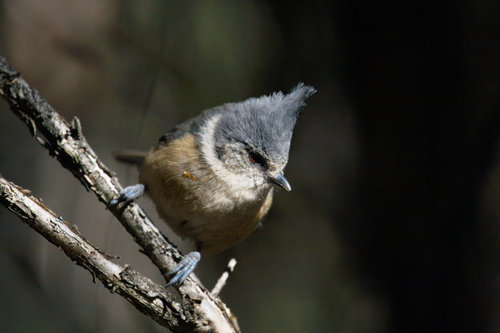
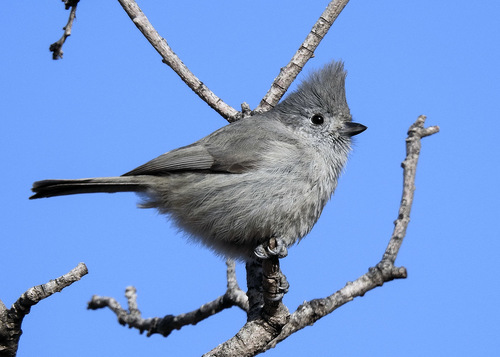
The juniper titmouse (Baeolophus ridgwayi) is a passerine bird in the tit family Paridae. In 1996, the American Ornithologists' Union split the former plain titmouse into the oak titmouse and the juniper titmouse, based on distinct differences in song, preferred habitat, and genetic makeup. The juniper titmouse is a small gray bird with a small tuft or crest. Males and females are visually identical. This species is a permanent resident across much of western North America; it lives year-round primarily in the Great Basin, with a range extending from southeastern Oregon and central Colorado south to the eastern Mojave Desert in California and central Arizona, reaching as far east as west Texas and extreme northeastern Sonora, Mexico, an area that includes the Madrean sky islands. It prefers warm, dry open woodlands including pinyon-juniper woodland, juniper woodland, and desert riparian woods. For roosting at night, juniper titmice sleep in cavities, dense foliage, or birdhouses. When roosting in foliage, the species selects a twig surrounded by dense foliage or an accumulation of dead pine needles, which creates conditions similar to roosting inside a cavity. Juniper titmice live in pairs or small groups, and do not form large flocks. After the breeding season, they may join mixed-species foraging flocks. The juniper titmouse diet includes insects and spiders, and individuals have been observed catching insects mid-flight. It also eats berries, acorns, and various seeds, and will sometimes hammer seeds against tree branches to open them. The species forages on foliage, twigs, branches, and trunks, and occasionally forages on the ground. Strong legs and feet let it hang upside down to reach food. Juniper titmice will also visit backyard bird feeders to eat suet, peanut butter, and seeds. The song of the juniper titmouse is a rolling series of notes all delivered on the same pitch. Its common call sounds like a raspy tschick-adee. This species builds its nest inside a woodpecker hole, natural tree cavity, or artificial nest box, lining the nest cavity with grass, moss, mud, hair, feathers, and fur. Breeding occurs from March through July, with peak breeding activity falling in April and May. Females lay between 3 and 9 eggs, most often 4 to 7. The female acts as the primary incubator, and incubation lasts 14 to 16 days. Hatchlings are altricial, and remain in the nest cared for by both parents for 16 to 21 days after hatching. Parents continue to care for fledglings for an additional three to four weeks after the young leave the nest. The juniper titmouse appears almost identical to the closely related oak titmouse, but the two species differ in voice and geographic range. The oak titmouse has a browner back than the juniper titmouse. The oak titmouse song is a repeated series of three to seven syllables, each made of one low and one high note, while the juniper titmouse's song is a sequence of rapid syllables all on the same pitch. The two species' ranges only overlap in a small area of California. The more distantly related tufted titmouse, whose range does not overlap with that of the juniper titmouse, can be distinguished by its whiter belly, rust-colored flanks, and black patch on the forehead.