About Baeolophus inornatus (Gambel, 1845)
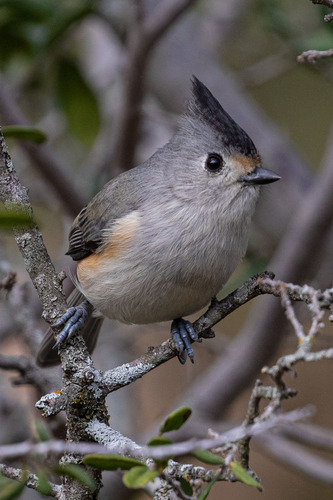
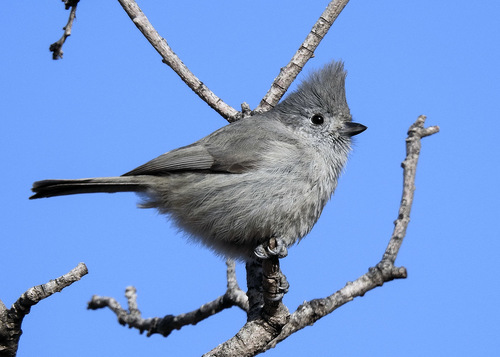
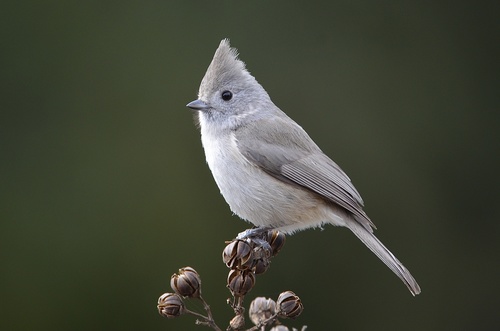
The oak titmouse (scientific name Baeolophus inornatus) is a passerine bird belonging to the tit family Paridae. In 1996, the American Ornithologists' Union split the formerly recognized plain titmouse into the oak titmouse and the juniper titmouse, based on distinct differences in song, preferred habitat, and genetic makeup. The oak titmouse is a small bird with brown-tinged gray plumage and a small tuft (crest). It has a plain face and lighter gray undersides. There is very little to no sexual dimorphism, so males and females look extremely similar. This species is a year-round resident on the Pacific slope, ranging from southern Oregon south through California west of the Sierra Nevada to Baja California, with its range surrounding the central San Joaquin Valley. It prefers warm, dry open oak and oak-pine woodlands at low to mid-elevations, but can also occur in other forests as long as enough oak trees are present. Within these habitats, oak titmice most commonly occupy areas with coast live oak (Quercus agrifolia) and valley oak (Quercus lobata). These tree species provide the sufficient cavities, dense foliage, and twig piles that oak titmice use for nesting. California oak woodlands currently face rapid decline from habitat fragmentation driven by rural residential sprawl and vineyard development. Low predation alongside this habitat change has contributed to high nest failure for the oak titmouse, so habitat conservation actions in California are needed to protect the species. Currently, the IUCN Red List classifies the oak titmouse as Least Concern. Even so, California's oak titmouse populations face threats from multiple human activities, including human-caused increases in wildfire frequency, land clearing for agriculture, and urban expansion. These pressures have caused a steady decline in oak woodland area, resulting in habitat loss that negatively impacts oak titmouse populations. Oak titmice roost in cavities, dense foliage, or birdhouses. When roosting in foliage, they choose a twig surrounded by dense foliage or an accumulation of dead pine needles, which mimics the structure of a cavity roost. They form pairs or small groups, and do not gather into large flocks. After the breeding season, they may join mixed-species foraging flocks. Pairs remain together year-round after the breeding season. The diet of the oak titmouse consists of insects and spiders; they are sometimes observed catching insects mid-flight. They also consume berries, acorns, and some types of seeds. This species forages on foliage, twigs, branches, and trunks, and occasionally forages on the ground. They sometimes hang upside down while foraging, and hammer seeds against branches to open them. Oak titmice will readily visit backyard feeders that offer suet, peanut butter, and sunflower seeds. For reproduction and nesting, the oak titmouse builds its nest in woodpecker holes, natural tree cavities, or artificial nest boxes, using materials including grass, moss, mud, hair, feathers, and fur. Nest building roles differ slightly: the female constructs the nest over a period of 4 to 10 days, while the male typically accompanies her and brings her food while she builds. Breeding occurs from March through July, with peak breeding activity in April and May. Females lay 3 to 9 eggs, most often 6 to 8 eggs. The female acts as the primary incubator, and the incubation period lasts 14 to 16 days. Hatchlings are altricial, and are cared for by both parents while in the nest for 16 to 21 days. After the young leave the nest, both parents continue to care for them for an additional three to four weeks. Researchers working in central California have found that oak titmice sometimes compete for nesting holes with other bird species, including western bluebirds and house wrens. Their nests are also sometimes taken over by the invasive European starling. As a result of this consistent nesting competition, oak titmice typically form pairs early, often stay paired for life, and defend the same territory year-round. According to research from Stanford University and the USGS, rising temperatures have caused the oak titmouse's breeding time to delay by approximately 20 days per decade in recent years. This shift has reduced the species' ability to adapt to the series of changes brought by climate change.