About Baeolophus bicolor (Linnaeus, 1766)
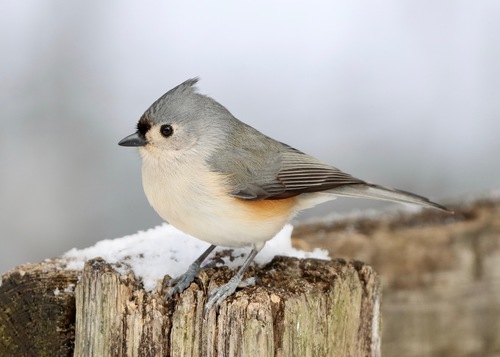
Measurements: Length 5.5–6.3 in (14–16 cm), Weight 0.6–0.9 oz (17–26 g), Wingspan 7.9–10.2 in (20–26 cm). The tufted titmouse is a small bird with a white belly, gray upper body, and rust-colored flanks. Key identifying features include a black forehead and a tufted gray crest on its head. Juveniles have a much less distinct black forehead, which can lead to confusion with the oak titmouse, though the two species do not share overlapping ranges. Males are typically larger than females. The species' song is most commonly described as a whistled peter-peter-peter, but it has around 20 notable variations. This species lives in deciduous and mixed forests, gardens, parks, and shrublands. It is nonmigratory; originally native only to the Ohio and Mississippi River basins, factors including bird feeders have allowed it to expand its range across much of the United States and into southern Ontario and Quebec, Canada. Its range has continued expanding northward since the second half of the 20th century into the 21st century. Tufted titmice forage for food on the ground and tree branches. Their diet includes a wide variety of berries, nuts, seeds, small fruits, insects, and other invertebrates; caterpillars make up a large portion of their diet during the summer. They are regular visitors to backyard bird feeders. Their typical feeding pattern is to scout feeders from nearby cover, fly in to grab a single seed, then return to shelter to eat it, though they also very commonly cache food for later. Tufted titmice are often curious about humans; they sometimes perch on window ledges to look inside homes, and may cling to building window frames and walls to hunt for prey in wasp and hornet nests. They are highly vocal, and will respond to alarm calls from other birds. They readily form small social flocks called troupes or banditries, which often join up with chickadees and other passerine birds while foraging.