About Baeolophus atricristatus (Cassin, 1850)
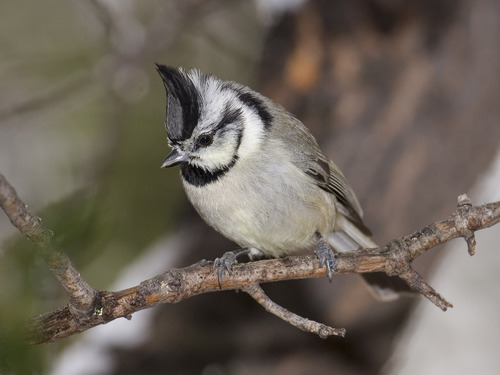
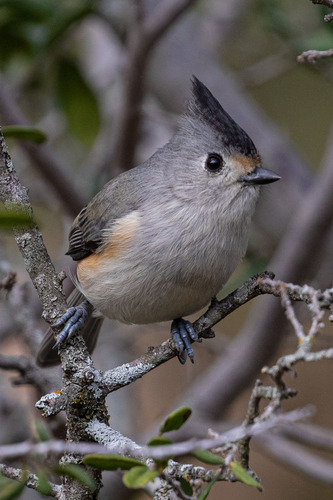
The black-crested titmouse (scientific name Baeolophus atricristatus, first described by Cassin in 1850) is approximately 15 cm (5.9 in) long and weighs around 16.5 g (0.58 oz). It is a moderately large member of its family, with a distinct crest, and the sexes have nearly identical plumage patterns.
For the nominate subspecies B. a. atricristatus, adult males have the characteristic black crest that gives the species its common name, while females have dark gray crests. Both sexes of the nominate subspecies share the same markings: a buffy-white forehead, white lores, a white eye-ring with a black spot just above it, and pale gray ear coverts. Their upperparts are a deep plumbeous gray, with a greenish tint on the mantle and rump. Their wings and tail are plumbeous gray; the primaries and tail feathers have greenish gray edges, and the primary coverts have pale gray edges. Their throat and underparts are white, and their flanks are a rich cinnamon-rufous. They have dark brown irises, black bills, and bluish gray to dark bluish legs and feet.
Juvenile black-crested titmice have shorter crests than adults. Juveniles have gray crests, buffy eye-rings, brown-washed wing coverts, grayish white underparts, and light pinkish buff flanks. Of the three recognized subspecies, B. a. paloduro is almost indistinguishable from the nominate B. a. atricristatus. B. a. sennetti has medium gray upperparts.
Each subspecies has its own distinct range: B. a. paloduro ranges from the Davis Mountains in western Texas south into northern Coahuila, Mexico, with a separate disjunct population in the Texas panhandle; B. a. sennetti ranges from southwestern Oklahoma south into central and southern Texas; the nominate B. a. atricristatus ranges from the lower Rio Grande Valley in Texas south through eastern Mexico to the states of eastern San Luis Potosí, northeastern Hidalgo, and central Veracruz. The species has been recorded as a vagrant in New Mexico. An unconfirmed sighting from Massachusetts has not been accepted by the state's Avian Records Committee.
The black-crested titmouse lives in a variety of landscapes, including evergreen, semi-deciduous, and deciduous forests and woodlands. It occurs in primary, secondary, and gallery forest types, and particularly favors habitats dominated by oaks (Quercus) and mesquite (Prosopis). It also lives in human-modified landscapes such as orchards, parks, and residential areas. Its elevational range extends from sea level up to approximately 2,300 m (7,500 ft).