About Baeckea gunniana Schauer ex Walp.
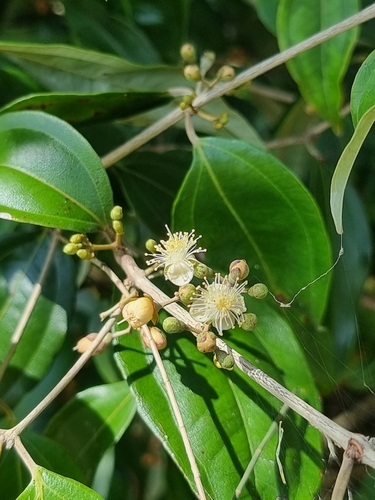
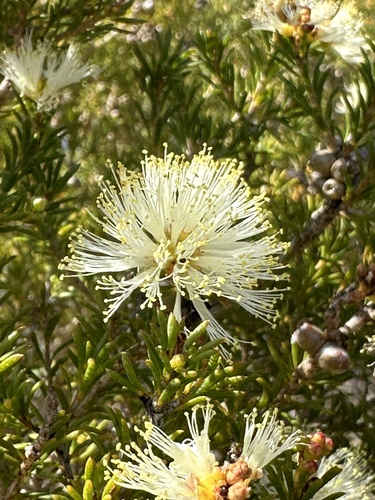
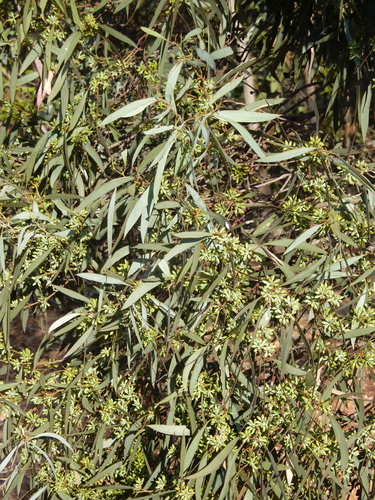
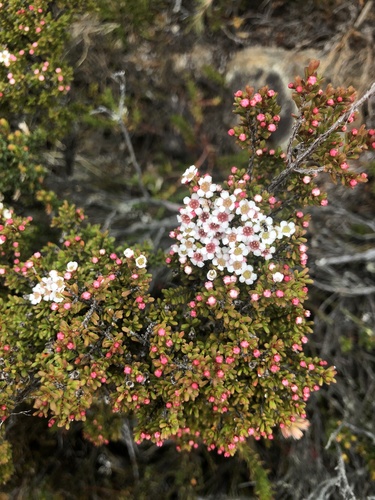
Baeckea gunniana Schauer ex Walp., commonly known as alpine baeckea, is a smooth, compact shrub that typically grows up to 1.5 metres (4 feet 11 inches) high, and can reach up to 2 metres (6 feet 7 inches) at lower altitudes. It is sometimes prostrate, spreading over rocks and boulders. Its branchlets have papery or fibrous brown bark. The leaves are crowded, elliptical to egg-shaped with the narrower end towards the base, 1.9–3.8 mm (0.075–0.150 in) long, 0.9–1.4 mm (0.035–0.055 in) wide, borne on a petiole about 0.5 mm (0.020 in) long, and have smooth edges. Flowers grow up to 5 mm (0.20 in) in diameter, are borne singly in upper leaf axils, and each sits on a pedicel 0.4–1 mm (0.016–0.039 in) long. The sepals are triangular to oblong, 0.6–0.8 mm (0.024–0.031 in) long, and the petals are white, more or less round, and 1.5–1.8 mm (0.059–0.071 in) long. There are four to six stamens, all about the same length. The ovary has a single locule, and the needle-shaped style sits in a small dent at the top of the ovary; this unilocular ovary is unique within the genus Baeckea. The fruit is a cup-like capsule, and the small, angular seeds remain inconspicuous on the ground after being released. Alpine baeckea is restricted to alpine or subalpine regions, ranging from Mount Ginini in the Australian Capital Territory and Mount Kosciuszko in south-eastern New South Wales to eastern Victoria and south-western Tasmania. It is most prevalent at high altitudes between 1,000 to 1,400 m (3,300 to 4,600 ft), but has been observed growing above 2,000 m (6,600 ft) near Mount Kosciuszko, and as low as 450 m (1,480 ft) in western Tasmania. It is commonly found growing alongside species such as Callistemon pityoides, Epacris paludosa, and Empodisma minus, in heathlands or boggy sedgeland. It is also common near creeks, and sometimes grows in shaded areas under Eucalyptus species. In New South Wales, this species forms an integral part of habitat for the broad-toothed mouse, providing protection from predators and large grazers. In horticulture, the seed coat (testa) of some Baeckea species acts as a physical barrier that inhibits seed germination. Germination rate can be improved by removing or nicking the testa with a needle or scalpel. B. gunniana can also be propagated vegetatively from cuttings of semi-hardened new growth. Baeckea leaves are edible, and are often used as a tea substitute for their aromatic citrus-like flavour. Extracts from B. gunniana have been found to inhibit the activity of DNA Polymerase enzyme.