About Badumna longinqua (L.Koch, 1867)
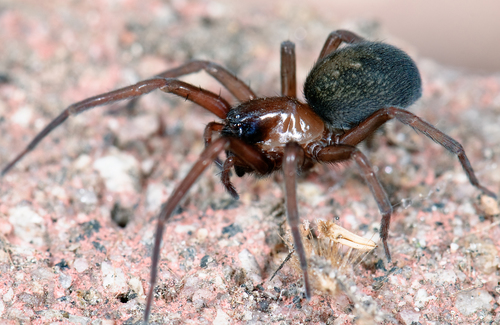
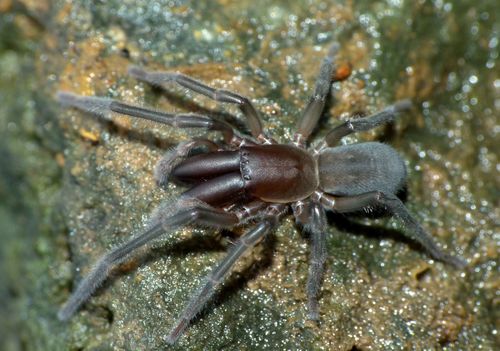
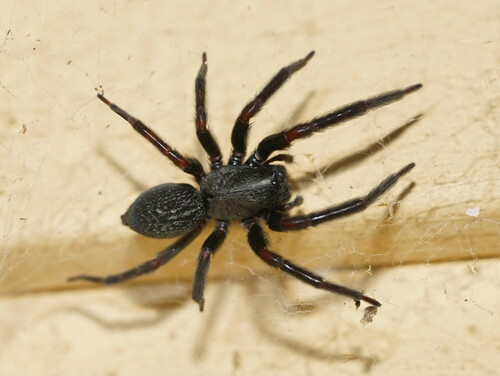
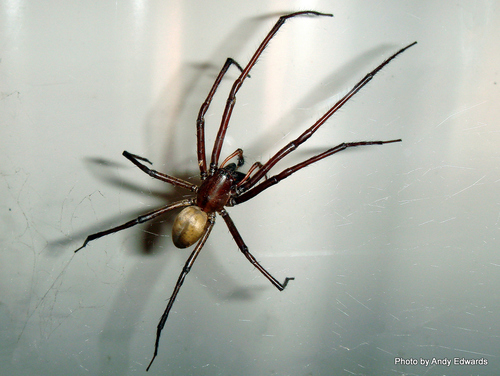
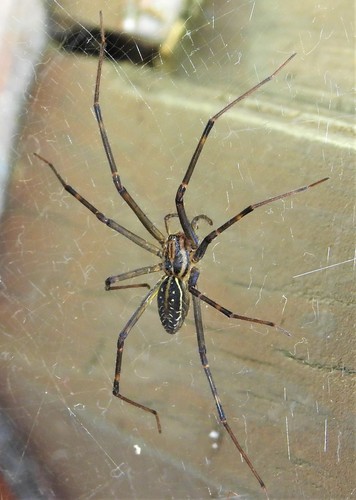
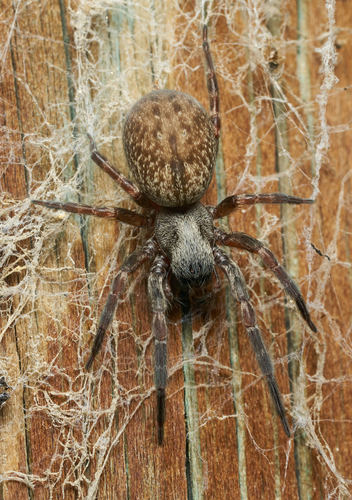
Badumna longinqua, commonly called the grey house spider, is an average-sized spider. Males reach a maximum body length of no more than 11 millimetres (0.43 in), while females are slightly larger, with a maximum body length of 15 mm (0.59 in). Its common name comes from its colouration: the cephalothorax and abdomen are covered in light-grey hairs and spot-like markings. The legs are purplish-brown, with hairs arranged into stripes on each leg. The similarly brown carapace darkens closer to the chelicerae and eyes. All eight of its eyes are small and black, except the front middle pair which are exceptionally large, around one and a half times the size of the surrounding eyes. Under these hairs, the abdomen is ovate. Badumna longinqua is originally native to eastern Australia. It was unintentionally introduced to New Zealand, where it is now widespread across both the North and South Islands. It occurs throughout the North Island, and only in selected parts of the South Island; it is less common in southern and western areas of the South Island due to unfavourable environmental conditions. Its colonisation of New Zealand has increased over the last decades as a result of human transport and trade. It most likely arrived during colonial times via inert phoresy on ships, planes, trains, and merchandise, and was first reported in New Zealand in the twentieth century. Its range expansion is driven by human activities, because B. longinqua can spread within transported goods such as ships, trains, and planes, which provide warmth and available food. Another speculated method of arrival is ballooning, a dispersal method for spiders where spiderlings release a thread of silk called gossamer that is carried away by wind or thermal updrafts, carrying the spider airborne. A closely related, slightly larger species, Badumna insignis, commonly called the common black spider or black house spider, has also colonised New Zealand, but only as far north as the northern part of the North Island. Aside from Australasia, B. longinqua has expanded its global range to include Argentina, Brazil, Germany, Japan, the United States, Uruguay, Canada, and South Africa. Badumna longinqua is mainly found in temperate climates, which occur in middle latitudes between the tropics and polar regions. While environmental conditions can limit a species' success, B. longinqua shows high tolerance and survival across varied climates. In most introduced countries including New Zealand, the grey house spider is a synanthropic species, common in urban habitats and agroecosystems. It resides almost exclusively in artificial environments created by human habitation, and does not live in wild habitats such as natural forests. The distinctive messy web of B. longinqua can be found in many urban locations, including nooks and crannies on window frames and walls, rubbish bins, under furniture, on car bodies and mirrors, tree bases and benches in urban parks, and artificial posies in cemeteries. Its presence in artificial flowers in cemeteries suggests it is very adaptable to finding suitable refuge. In natural areas, the species is primarily found on tree trunks, rock walls, in retreats, among leaves, and in tangled webbing in green shrubs. It also lives in grasslands, riparian forests and wetlands. Higher population densities of the species are found in trees near roads or urban areas with higher human activity. Commercial Eucalyptus plantations in Uruguay, and Pinus plantations elsewhere, provide an abundance of potential shelter for the spiders, which often settle on the trees and position their hideaways under loose bark. In the United States, B. longinqua seems less dependent on a synanthropic relationship with humans, and can also be found in woodlands, along immediate coastal areas, within agricultural ecosystems, and recently in vineyards. Female B. longinqua can potentially spend their entire life in the same web, while sexually mature males must leave their retreat when it is time to reproduce. Males search for females during the warmer months of the year, from summer through early autumn. Although details of B. longinqua courtship have not yet been formally described, and the species' overall biology is not well studied, it is generally accepted to be a solitary spider. The lifespan of B. longinqua has not been officially documented. However, its closest relative Badumna insignis lives for a maximum of around two years, so it is hypothesised that B. longinqua has a similar lifespan.