About Badumna insignis (L.Koch, 1872)
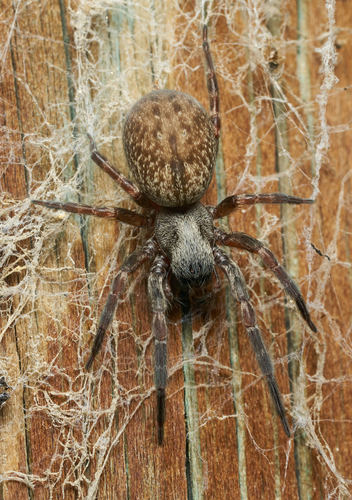
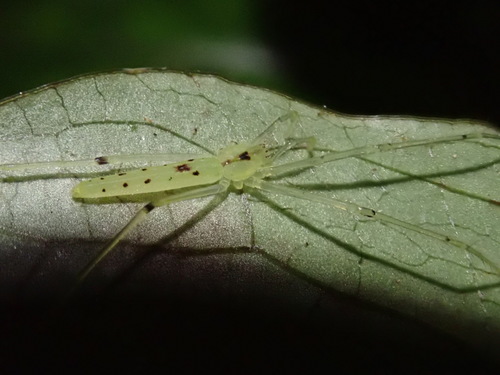
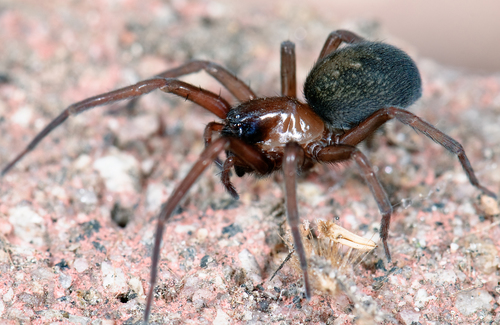
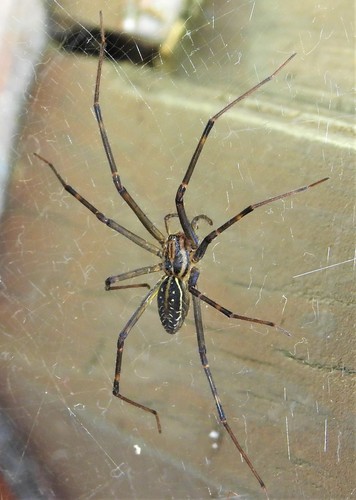
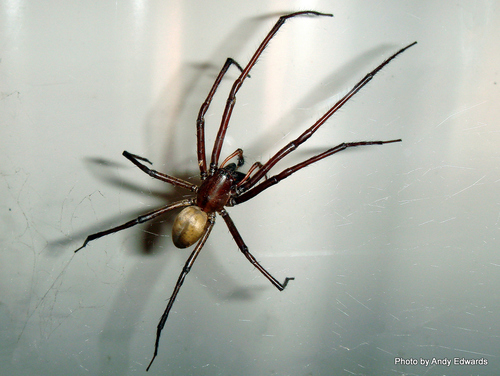
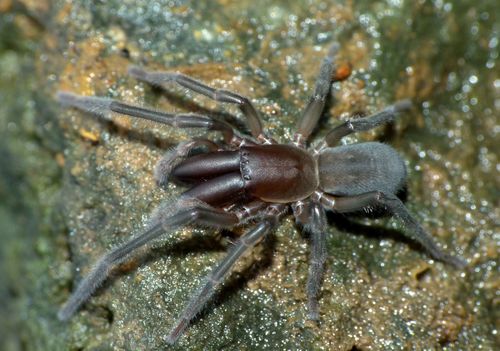
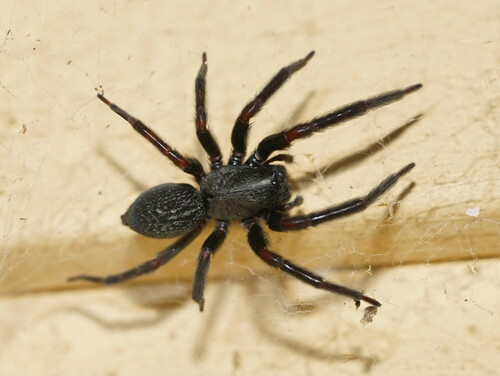
Badumna insignis is a dark, robust spider species. Females grow up to 18 millimeters in body length, with a 30-millimeter leg span. Like most spider species, males are smaller at 10 millimeters body length, and have longer legs relative to their body size. In both sexes, the carapace and legs range from dark brown to black. The abdomen is charcoal grey, with a dorsal pattern of light markings that are sometimes indistinct, and is covered in a dense layer of fine, velvety hair. The closely related species Badumna longinqua is slightly smaller, reaching a maximum body length of 14 millimeters, and has a greyish carapace with black-brown legs. Badumna insignis is native to Australia, and has been introduced to New Zealand and Japan. It is widely distributed across both Australia and New Zealand. In its natural habitat, it is most often found on rough-barked trees. Inside buildings, it is commonly spotted in corners, around windows and doorways, or near other light sources that attract insect prey. The related Badumna longinqua can be found in similar locations, but is more often found outdoors. The web of Badumna insignis is a messy, irregular structure shaped like an uneven sail. It has a funnel-shaped silken retreat, usually located in the middle or a corner of the web, where the spider spends most of its time waiting for prey. Female Badumna insignis never leave their web unless forced to do so. They stay strongly attached to their location, and rarely change the position of their webs. As a result, older webs become quite messy, and often have small objects or dust stuck in them. At night, the spider comes out to repair its web and add new silk, usually just laying new silk over the existing old silk. When males are ready to mate, they travel to search for females. A male plucks the female's web to get her attention. After confirming the female is receptive, he approaches and inseminates her with his palps. The pair may then stay together for several days, and may mate multiple additional times. The female builds several white silk egg sacs, which she anchors inside her web retreat. She stays with the eggs until they hatch. After hatching, spiderlings may either disperse, or remain in their mother's web for some time, catching smaller prey that the larger mother spider would ignore. Known predators of Badumna insignis include the white-tailed spider, as well as parasitic wasps and flies.