About Bactrocera dorsalis (Hendel, 1912)
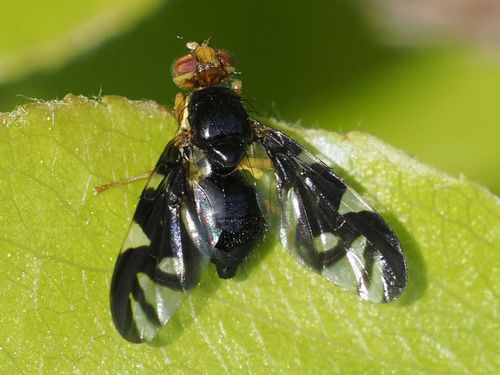
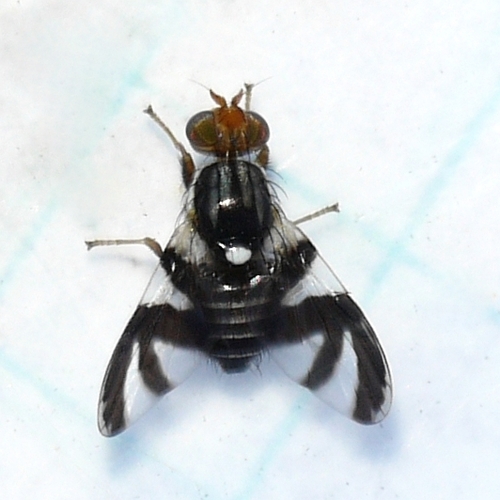
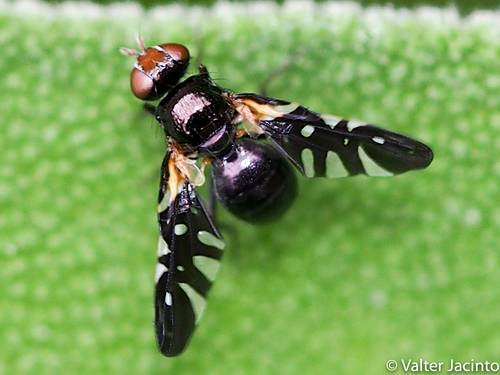
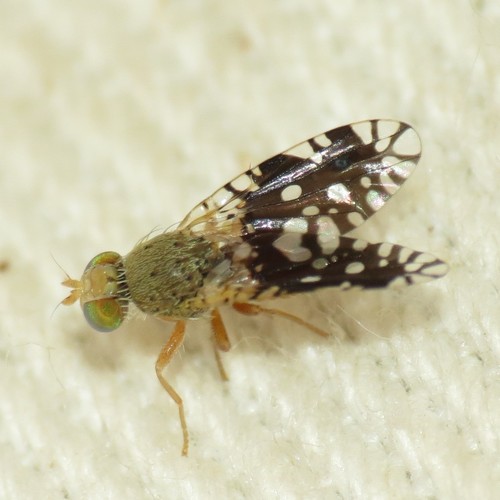
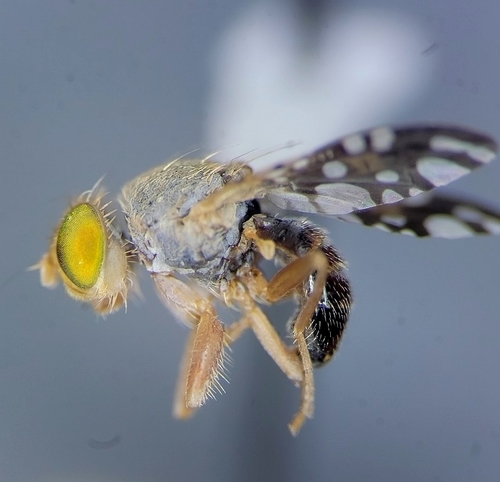
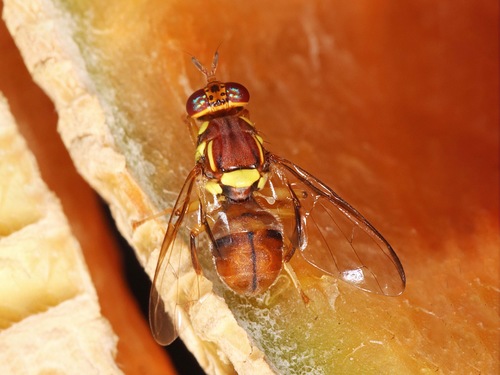
Bactrocera dorsalis, first formally described by Hendel in 1912, is a species of tephritid fruit fly. Most flies in the tephritid family are small to medium-sized with colorful markings. This species is part of the Bactrocera dorsalis complex, a group of closely related, physically similar flies. Members of this complex are defined by having a mostly black thorax and a dark T-shaped marking on the abdomen, which is formed by a dark medial band and a dark transverse band across the abdomen. B. dorsalis has variable yellow and black markings across its thorax and abdomen. It can be distinguished from its close relatives by two vertical yellow markings on the thorax and the dark T-shaped abdominal marking. Its wings are clear with a continuous costal band. Adult individuals have a total body length of around 8.0 mm, and their wings measure approximately 7.3 mm in length. Adult females have a tapered ovipositor that they use to deposit eggs inside host fruits, while males lack this structure entirely.
Originally endemic to Southeast Asia, B. dorsalis is a highly invasive pest species that is now present in at least 65 countries. It has been introduced to Hawaii, the Mariana Islands, and Tahiti, and is also widespread across most sub-Saharan African countries. Between 1910 and 1990, the species was only recorded in 5 countries, but its rate of spread increased sharply over the following three decades, during which it invaded an additional 70 countries. Outside of Hawaii, B. dorsalis has been observed in California and Florida in the mainland United States. Each observation triggers eradication efforts. Four major eradication campaigns for oriental fruit fly were carried out in response to California infestations between 1960 and 1997. Two more infestations were eradicated in 2006 and 2007, with eradication completed within 3 to 4 years of the initial infestation reports. In July 2010, flies were found in traps in California's Sacramento and Placer counties, leading to the establishment of a quarantine followed by eradication work. All mainland United States sightings of this species have generally been quarantined infestations that were successfully eradicated.
Researchers have used the CLIMEX modeling software to map potential future distribution changes for B. dorsalis, testing projections under both current climate and future predicted climate conditions related to climate change. Under current conditions, the model projects the fly could spread across most of the tropics and subtropics, extending into regions such as Mediterranean Europe, and identifies the southeast United States as having optimal climate conditions for the species. Under projected climate change conditions, overall potential spread increases because cold weather becomes less of a limiting factor, but potential distribution may decrease in regions where precipitation is predicted to decline.
B. dorsalis is found in tropical habitats. For pupation, this species prefers shaded areas over brightly lit areas, moist soil over dry soil, and soil with larger particles (particle size of 2.5 mm or larger) over soil with smaller particles. Documented regions where B. dorsalis occurs include the United States, China, the United Arab Emirates, the rest of Southeast Asia, India, Brunei, Malaysia, the Philippines, the Mariana Islands, Timor Leste, Pakistan, Taiwan, and the rest of South Asia. One male fly has recently been found in New Zealand, but it remains unclear whether a breeding population has become established there.
B. dorsalis has been recorded on more than 200 species of fruit and nut plants, but it most often lays its eggs in mango, papaya, and avocado fruits. Adult B. dorsalis feed on decaying fruit, plant nectar, and other substances throughout their lives, and they prefer to feed during the morning.