About Bactris gasipaes Kunth
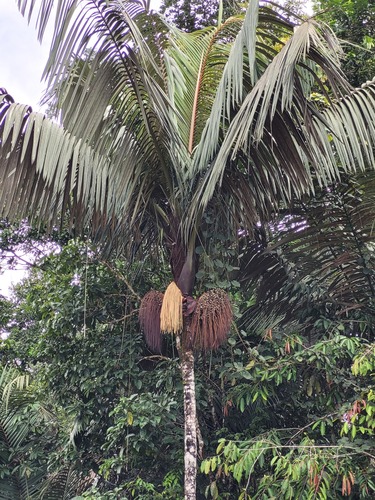
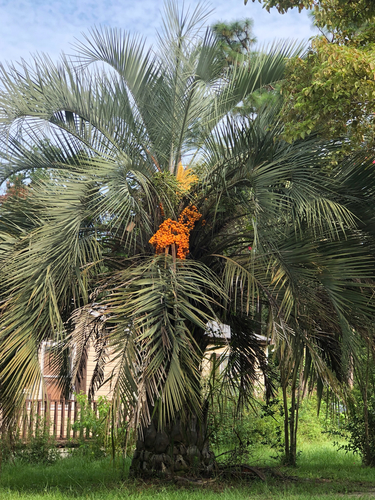
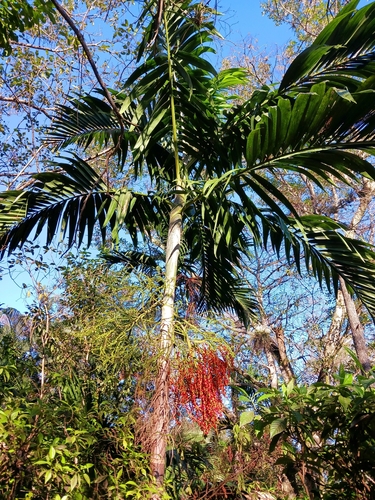
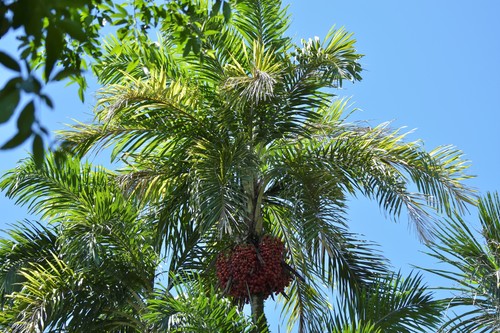
Bactris gasipaes Kunth, also known as peach palm, grows erect like most sea-island palms. It typically has a single slender stem, or more often a cluster of several stems that reach up to 20 cm (eight inches) thick. The plant is generally armed with stiff, black spines arranged in circular rows from the base to the summit, though occasional specimens have only a few spines. It usually grows to 20 metres (66 ft) or taller. Its trunk has a hard outer ring of black fibers embedded in a lighter tan or light brown inner tissue. Fibers are most densely packed toward the trunk’s outer edge, and become increasingly sparse toward the center. The trunk’s central core is soft, and lacks the darker vascular bundles that give the wood its characteristic appearance and hardness. Its leaves are pinnate, reaching 3 metres (9.8 ft) in length, attached to a 1 metre (3.3 ft) long petiole. Its fruit is a drupe 4–6 cm long and 3–5 cm broad, with edible pulp surrounding a single seed. When ripe, the fruit’s outer rind (epicarp) may be red, yellow, or orange, depending on the palm variety. In its wild state, peach palm grows in well-drained soils across a range of physical and chemical conditions, including acidic and poor-quality soils, due to its beneficial association with mycorrhizas. It is cultivated in climates with annual precipitation between 2000 mm and 5000 mm, and mean annual temperatures above 24 °C. The recommended altitude range for commercial cultivation is 0 to 900 m above sea level. It occasionally occurs at altitudes as high as 1800 m asl, for example at El Tambo in Colombia’s Cauca region. Peach palm is considered the most important domesticated palm species of the Neotropics. Wild and domesticated populations occur across Central America, the Pacific lowlands of Colombia and Ecuador, Venezuela, and the Amazon rainforest area, especially along the eastern foothills of the Andes. The exact origin of cultivated peach palm is still debated. Widespread cultivation of the species across the Americas reflects its ability to adapt to a broad range of ecological conditions in tropical and subtropical regions. Both wild and cultivated populations have very high genetic diversity, which could provide useful traits for breeding programs. Genetically, peach palm can be divided into two main groups: two western populations found in Central America, the Andean valleys of Colombia and Venezuela, and the Pacific lowlands of Colombia and Ecuador; and two eastern populations found in the upper and eastern Amazon. In general, western populations have harder stems, more abundant and stronger spines, larger leaves, and more solid rooting during the juvenile phase. Peach palm is a predominantly outcrossing species, though self-fertilization has also been observed. Pollination is mainly done by insects, especially small curculionid beetles, across distances between 100 and 500 m. Wind and gravity can also act as pollen vectors. As a long-lived perennial, predominantly outcrossing species, peach palm populations have high genetic diversity. While no definite studies on peach palm seed dispersal have been conducted, dispersal is probably limited to local movement by birds and seed-gathering mammals. Seeds are only occasionally dispersed over greater distances by water. For outcrossing tree species with this scattered distribution, gene flow may be restricted, which can lead to genetically distinct, isolated subpopulations with small effective population sizes. Unlike cultivated peach palm, wild populations are threatened by deforestation, driven mainly by agricultural expansion and the conversion of forest to savannah. Many wild populations are now isolated by increasing forest fragmentation, which will cause reduced reproduction through inbreeding depression and eventual extinction even without complete deforestation. The full natural distribution of wild peach palm is not yet well understood. Wild peach palm trees grow in disturbed ecosystems, on river banks, and in primary forest gaps, and they often occur in isolation or at low densities. Bactris gasipaes has been used as food for centuries. Spanish explorers recorded a 30,000-tree pejibaye plantation on Costa Rica’s Atlantic coast, where the fruit replaced corn in the indigenous diet. The fruit is stewed in salted water, peeled, and had its seed removed, and may be seasoned with salt or honey. Its texture, both raw and cooked, has been compared to a firm sweet potato, and its flavor compared to hominy, dry squash, or roasted chestnut. In some regions, halved fruit are filled with mayonnaise or sour cream. Raw peach palm contains irritating calcium oxalate crystals that break down under intense heat. Fruit sellers, often street vendors, traditionally cook the fruit for 5 hours the night before sale; however recent studies show the same result can be achieved in 30 minutes in a pressure cooker, or even less in dry ovens or microwaves, without significantly altering the final product’s flavor. Raw fruit spoils quickly, but it can be stored as a dry meal or preserves. It can be processed into flour and edible oil. Additionally, peach palm chips, currently produced in southern Colombia, are thought to have high potential to enter mainstream consumer markets. This plant is also harvested for heart of palm, and has commercial advantages from its fast growth rate: the first harvest can occur 18 to 24 months after planting. Brazil has a large domestic market for heart of palm, and international demand is growing. It is also an economically important crop in Costa Rica. It is a viable substitute for other heart of palm sources, such as overexploited native Euterpe species including Euterpe oleracea (açaí) and Euterpe edulis (juçara). It could also become a replacement crop for the threatened Fiji sago palm (Metroxylon vitiense).