About Bacidia rubella (Hoffm.) A.Massal.
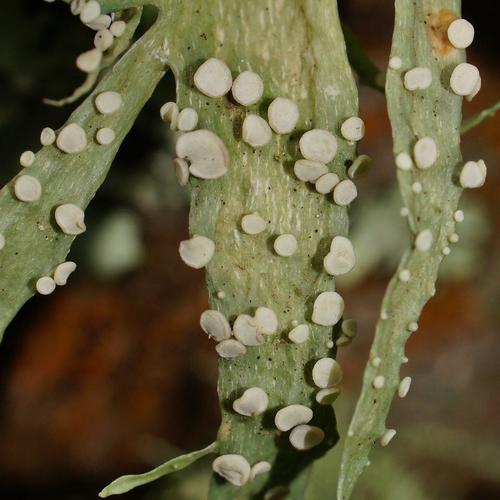
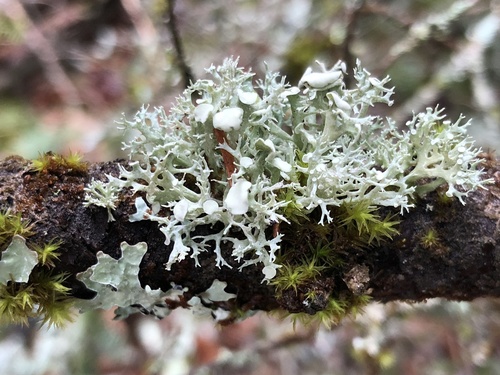
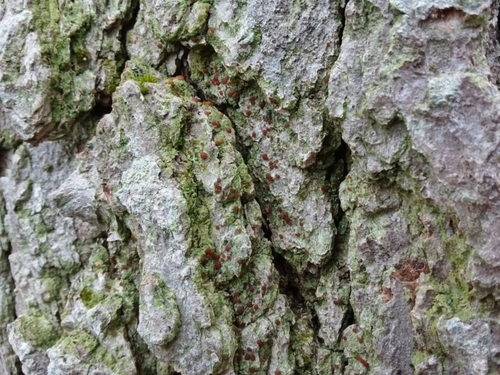
Bacidia rubella (Hoffm.) A.Massal. is a lichen species defined by specific morphological features. Its main body, called the thallus, ranges in colour from grey to yellow-green. It has a distinctive texture that varies from thinly to richly granular-isidiate, meaning it is covered with small granular reproductive structures called isidia that measure 60–120 μm in diameter. The cells of its photosynthetic algal partner, the photobiont, are 5–17 μm in diameter. Fruiting bodies called apothecia are often absent in this species. When present, they typically measure 0.7–1 mm in diameter, are usually distinctly constricted at the base, are flat and sometimes become convex, and range in colour from pale to dark red-brown. The apothecia margin is sometimes covered with a white, powdery coating called pruina. The true exciple, the apothecium's outer rim, is colourless in its lower part, while the upper part is pale yellow-orange or yellow-straw coloured. In specimens with pruinose margins, the exciple sometimes shows radiating streaks of tiny crystals. The exciple is made of fungal filaments called hyphae, with internal spaces (lumina) that measure 1–2 μm in diameter, reaching up to 5 μm in diameter toward the outer edge. The spore-producing layer, the hymenium, is 70–105 μm high and is either colourless, or faintly orange-red or yellow in its upper part. The tissue below the hymenium, called the hypothecium, is colourless, or pale yellow or orange-straw coloured in its upper part, and may intensify to yellow when treated with potassium hydroxide solution (K). Sterile filaments that grow between the spore sacs, called paraphyses, are 1–1.5 μm in diameter, are either unbranched or forked in their upper portion, and their tips often swell slightly to about 2.5 μm in diameter. The fungal spores produced in spore sacs, called ascospores, typically measure 40–70 by 2.5–3 μm, are needle-shaped (acicular), and have 3 to 7 cross walls (septa), occasionally up to 13 septa. Asexual reproductive structures called pycnidia are 85–125 μm in diameter and range in colour from pale pink to red-brown. Asexual spores called conidia measure 16–24 by about 0.5 μm and are curved or S-shaped (sigmoid).
In the United Kingdom, Bacidia rubella occurs mainly on the bark of mature trees, particularly those with nutrient-rich bark surfaces such as maple (Acer), ash (Fraxinus), and elm (Ulmus). It is typically found in parklands, along roadsides, and in woodlands growing on fertile soils. On rare occasions, it may also grow on sheltered gravestones or walls. This species is widespread throughout Britain and Ireland, but becomes less common in western Scotland and is absent from areas affected by pollution. Bacidia rubella is broadly distributed beyond the United Kingdom, occurring across much of lowland central and northern Europe. Within the Mediterranean region, it typically grows in montane areas with more continental climates than coastal or lowland related species. Bacidia rubella is nitrophilous, meaning it favours habitats enriched by nutrients. This ecological adaptability allows it to grow in a variety of continental environments, although it generally avoids heavily polluted areas. The species' occurrence across diverse climatic and ecological zones highlights its adaptability within the Bacidia rubella group.