About Baccharis sarothroides A.Gray
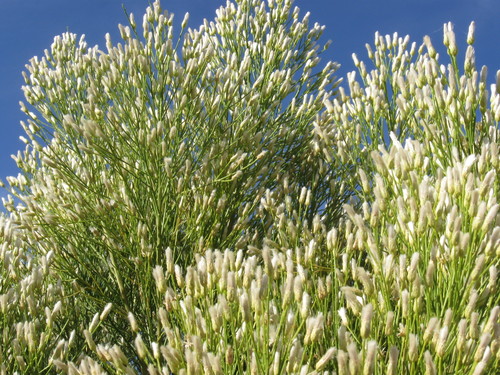
Baccharis sarothroides A.Gray is a North American flowering shrub species. Its common English names include broom baccharis, desertbroom, greasewood, rosin-bush and groundsel, and its common Spanish names are "escoba amarga" and "romerillo". This is a spreading, woody shrub that is usually sticky from glandular secretions along its mostly leafless green stems. Its small, thick leaves are only a few centimeters long, and are absent for much of the year, giving the shrub a spindly, twiggy appearance. It produces abundant tiny green blooms, with male and female flowers occurring on separate individual plants. It is native to the Sonoran Desert of northwestern Mexico (found in Baja California, Baja California Sur, Sinaloa, and Sonora) and the Southwestern United States (found in southern California, Arizona, New Mexico, and western Texas), where it commonly grows in gravelly dry soils and disturbed areas. The Seri people call this desert broom cascol caaco, and prepare a decoction by cooking its twigs. The resulting drink is used to treat colds, sinus headaches, and general sore achy conditions. The same tea can also be used as a rub for sore muscles. Studies of plant extracts from this species show that desert broom is rich in luteolin, a flavonoid that has shown anti-inflammatory, antioxidant, and cholesterol-lowering properties. Desert broom also contains quercetin, a confirmed antioxidant, and apigenin, a chemical that binds to the same brain receptor sites that Valium acts on. However, many members of the Sunflower family contain compounds that cause negative side effects, so caution is advised until more extensive testing of this plant is completed.