About Baccharis latifolia (Ruiz & Pav.) Pers.
Baccharis latifolia belongs to the Baccharis genus, which includes perennial plants and shrubs in the aster family Asteraceae. Members of this genus are commonly called baccharises, and are sometimes referred to as "brooms" because many have small thin leaves that look like the leaves of true brooms. Despite this common name, Baccharis is not related to true brooms, and belongs to a completely different eudicot lineage. One species, B. halimifolia, is commonly known as groundsel bush, but true groundsels actually belong to the separate genus Senecio.
With over 500 species, Baccharis is one of the largest genera in the Asteraceae family. The genus is found across the Americas, distributed mainly in the warmer regions of Brazil, Argentina, Colombia, Chile and Mexico. B. halimifolia ranges further north along the Atlantic Coast to the southern tip of Nova Scotia, Canada.
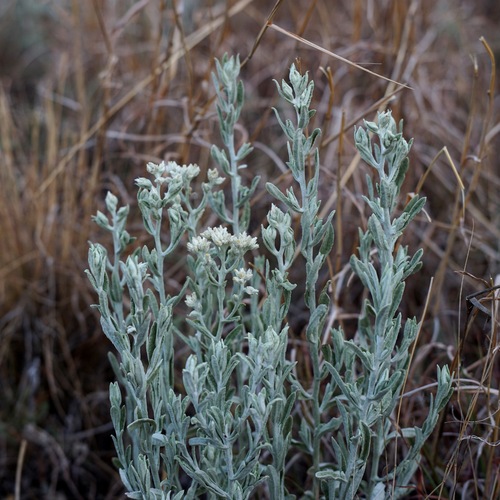
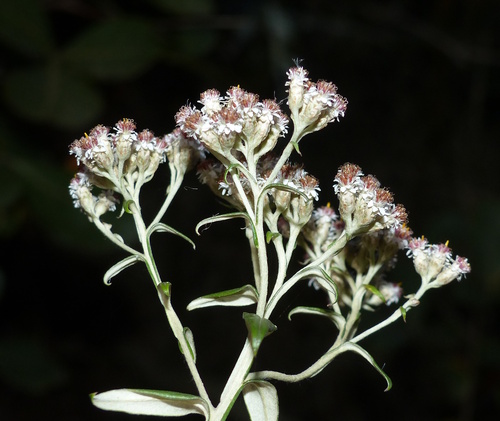
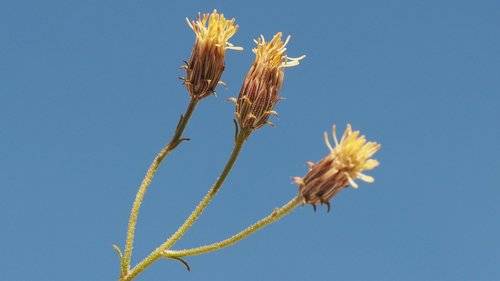
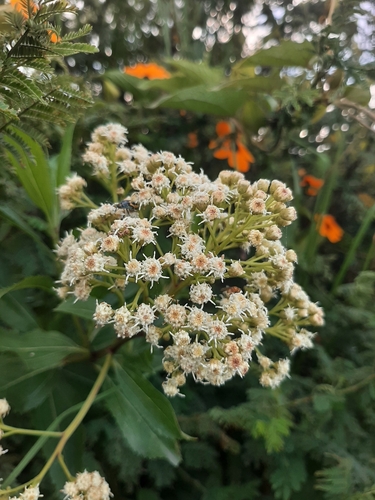
When leaves are present on Baccharis plants, they grow in an alternating pattern along the stems. Flowers are usually white or pinkish. There are no ray flowers, but many disk flowers, which are either staminate or pistillate. Some species of Baccharis are toxic to animals; specifically, consumption of B. coridifolia may cause gastrointestinal tract necrosis in cattle, horses, sheep, and rabbits. The genus name Baccharis comes from Bacchus, the Roman god of wine also known as Dionysus.
In ecological interactions, larvae of some Lepidoptera species use Baccharis as a food source. This includes the swift moths Phymatopus californicus and P. hectoides. The larvae of leaf-miner moths Bucculatrix dominatrix and B. seperabilis feed exclusively on B. pilularis (bush baccharis). B. ivella has been found on eastern baccharis, and the polyphagous B. variabilis has been recorded feeding on various Baccharis species. Polyphagous Coleophora case-bearers C. linosyridella and C. viscidiflorella have larvae recorded on bush baccharis as well as other plants. Caterpillars of the owlet moth Schinia ocularis feed exclusively on B. sarothroides (broom baccharis).
Baccharis conferta, a species native to Mexico, was used as a nurse plant to protect newly planted Abies religiosa tree seedlings from frost and drought in the world's first assisted migration experiment. This experiment paired upslope planting of the fir trees in anticipation of climate change forcing overwintering Monarch butterflies to move to higher elevations in central Mexico.
For uses, several Baccharis species are cultivated because their dense but flexible stem structure makes them effective windbreaks. Plants in this genus are rich in terpenes, and some species are used in native or folk medicine. Viscidone is a compound specifically described from Chilean and Argentinean Baccharis. Baccharis flowers are rich in nectar, so several species are good honey plants. B. dracunculifolia in particular is highly valued by beekeepers.