About Babiana vanzijliae L.Bolus
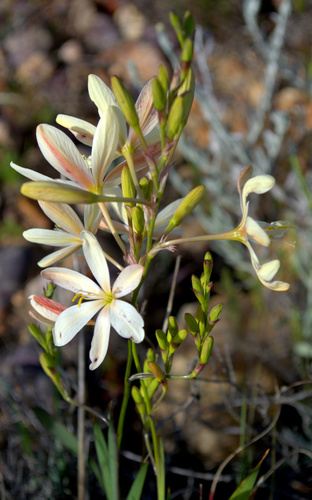
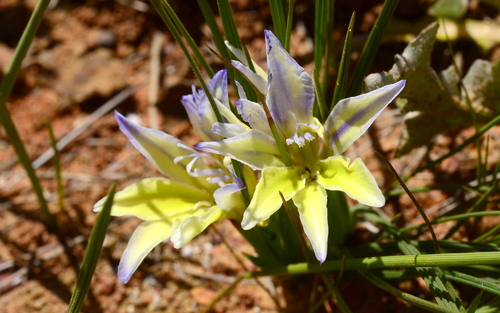
Babiana vanzijliae is a geophytic perennial plant that grows 4–12 cm (1.6–4.7 in) tall. Most of its velvety stem grows underground, with only a portion above the surface, and it may branch at ground level. A thick fibrous collar encircles the stem base, which is visible at the soil surface. Its leaves each have a sheath that encloses the sheaths of leaves growing higher up, and a leaf blade positioned at an angle to the sheath. The leaf blade is either upright or sickle-shaped, covered in velvety hairs, and laterally compressed, meaning it has distinct right and left sides rather than upper and lower sides. The leaf surface is not flat, but pleated: the leaf surface changes angle abruptly and repeatedly at each vein. The leaf blade has a sword-shaped to narrowly lance-shaped outline, is not coiled, has non-undulating margins, and ends in a sharp tip that does not have multiple irregular teeth. Its decumbent inflorescence holds three to five upright, bilaterally symmetrical flowers. Each flower is subtended by two bracts 25–40 mm (0.98–1.57 in) long, which are green at the base and dry at the tip; the outer bract is slightly longer than the inner. The inner bract is only forked at the tip, which distinguishes it from many related species that have more deeply forked inner bracts, or inner bracts split all the way to the base. The flowers are pale to clear yellow, sometimes flushed with pale mauve-blue or mostly pale mauve-blue overall, and produce an intense scent. The flower has a narrowly funnel-shaped perianth tube 25–50 mm (0.98–1.97 in) long, sometimes as short as 18 mm (0.71 in), that divides into six tepals. The dorsal tepal arches over the anthers and style, and is 30–38 mm (1.2–1.5 in) long. The three lower tepals are 25–30 mm (0.98–1.18 in) long, and are fused together for a short distance to form a lower lip that acts as a landing platform for visiting insects. The lower lateral tepals are yellow with paler edges. Three filaments are crowded along the side of the dorsal tepal, measure 15–17 mm (0.59–0.67 in) long, and are tipped with 7–8 mm (0.28–0.31 in) long anthers. The inferior ovary is smooth, or sometimes has short bristly hairs only on its ribs. The style arches over the stamens and divides into three branches opposite the anther tips; each branch is about 4 mm (0.16 in) long. Flowering occurs from early August to mid-September. This species occurs on the high plateau bordering the escarpment, from just north of Nieuwoudtville Pass to Papkuilsfontein Farm in the south, and extends around 15 km (9.3 mi) inland from the escarpment. Within this range, it grows in both renosterveld and fynbos vegetation, in tillite-derived soils and on rocky sandstone. It is classified as a near-threatened species. Its distribution covers an area less than 600 km² (230 mi²), where it occurs in 10 to 15 locations, and its population is declining as its habitat is converted for rooibos and wheat cultivation, though the species remains fairly common at present.