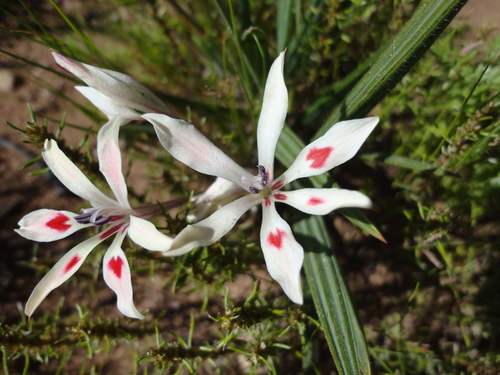
About Babiana tubiflora (L.f.) Ker Gawl.
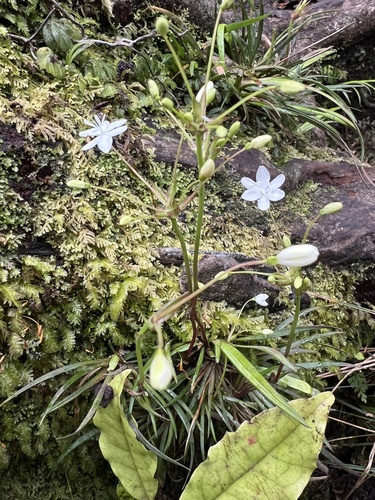
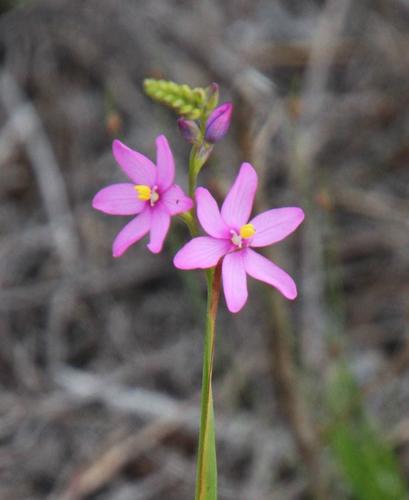
Babiana tubiflora is a perennial species that grows 7–15 cm (2.8–5.9 in) tall, emerging from an underground globular corm at the start of its growing season. Its stem is covered in dense white velvety hairs, and unlike almost all other Babiana species, it lacks the fibrous collar at the point where it emerges from the ground. It often produces slender runners to carry out vegetative reproduction. Its leaves are linear to lance-shaped, 3–6 mm (0.12–0.24 in) wide, and may be smooth or sparsely hairy. The leaf blade is laterally compressed, meaning it has right and left surfaces rather than upper and lower surfaces, and is pleated: leaf surfaces abruptly change angle repeatedly at each vein location. Each flower is subtended by two bracts that measure 35–60 mm (1.4–2.4 in) long. The outer bract is two to four times as long as the inner bract, and clasps the inner bract. Both bracts are covered in velvety hairs, are green except for their dry brown tips, and the inner bract is only forked at its tip. The inflorescence usually holds six to twelve scentless, whitish, bilaterally symmetric flowers. The flowers have a fused perianth tube that is 60–80 mm (2.4–3.1 in) long, rarely reaching as short as 45 mm (1.8 in) or as long as 100 mm (3.9 in), with six tepal lobes. The tepal lobes are narrower near their base. The dorsal tepal lobe is only slightly larger than the other lobes, at 18–23 mm (0.71–0.91 in) long. The three lower tepals are 3–4 mm (0.12–0.16 in) wide, and often bear a small, roughly heart-shaped pink to raspberry red marking. The three stamens are crowded under the dorsal tepal, with curved filaments 13–16 mm (0.51–0.63 in) long, topped by anthers 4–5 mm (0.16–0.20 in) long. The ovary is hairless, topped by a long, thread-like style that splits into three 3–4 mm (0.12–0.16 in) long branches opposite the upper half of the anthers, or slightly above the anther tips. Flowers bloom from August to usually mid-September, and occasionally into early October.
Babiana tubiflora occurs in the Western Cape province of South Africa, found inland around Piketberg and Darling, and along the coast between Lambert's Bay at its northwestern limit and Stilbaai to the southeast. It is pollinated by the long-tongued fly Moegistorhynchus longirostris. Unusually for a Babiana species, self-fertilization results in high seed development; this trait is only known to be shared with B. ringens in this genus. Seeds of this species take approximately three years to grow into mature, flowering plants. This species grows in sandy strandveld and fynbos habitats on coastal flats and dunes. It has a distribution area of 47,000 km² (18,000 mi²) and is known from more than ten locations that are not highly fragmented. The species is declining due to substantial habitat loss caused by agricultural expansion, coastal development, and urban development. It has been lost locally in several areas, most prominently on the Cape Flats. While the species is tolerant of severe disturbance, coastal development continues, and habitat loss in this region is irreversible. The species is currently not considered threatened, is classified as a least-concern species, but requires ongoing monitoring.