About Azorella compacta Phil.
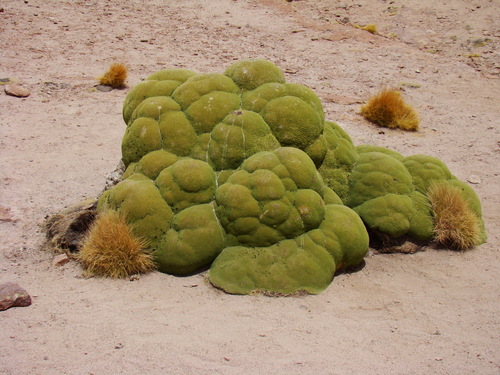
This plant, commonly called yareta, has the scientific name Azorella compacta Phil. It is an evergreen perennial that grows in a low, mat-like, hemispherical form, reaching around 6 meters (20 feet) in diameter. Its pink or lavender flowers are self-fertile, hermaphroditic, and are primarily pollinated by small flies, bees, wasps, and moths. Yareta prefers sandy, well-drained soils, and can grow in nutritionally poor soils that are acidic, neutral, or alkaline. It grows at altitudes up to 5,200 meters (17,100 feet). Yareta is well-adapted to the high insolation rates common to the Andes highlands, and cannot grow in shade. Its leaves form an extremely compact, dense mat that reduces heat and water loss. This mat grows close to the ground, where the air temperature is one to two degrees Celsius warmer than the mean ambient air temperature. This temperature difference comes from longwave radiation re-radiated by the usually dark gray to black soil surface found in the Puna. On average, yareta grows approximately 1.5 centimeters (0.59 inches) per year. Many individuals are estimated to be over 3,000 years old. The oldest reported yaretas grow as slowly as 1.4 millimeters (1⁄18 inch) per year. Due to this extremely slow growth, the traditional practice of harvesting yareta for fuel is highly unsustainable.