About Azanus jesous (Guérin-Méneville, 1847)
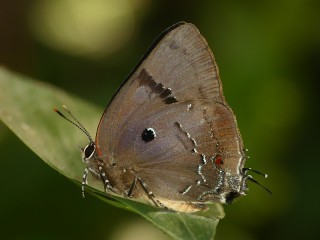
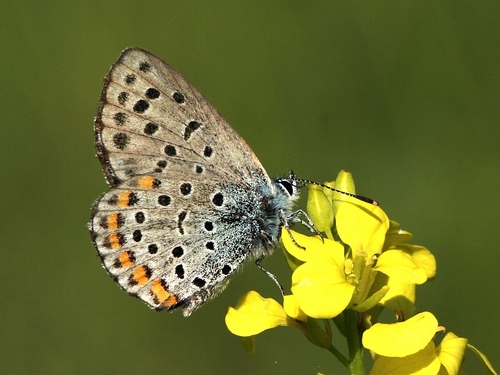
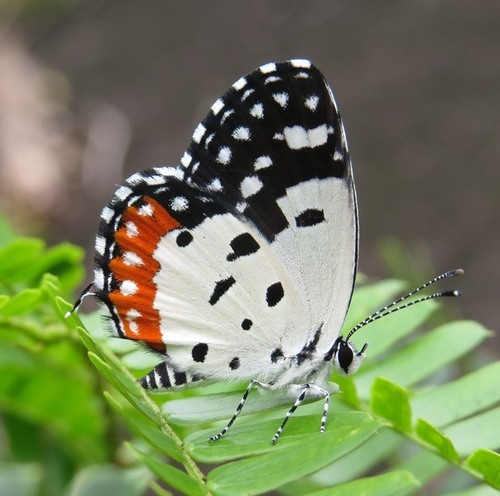
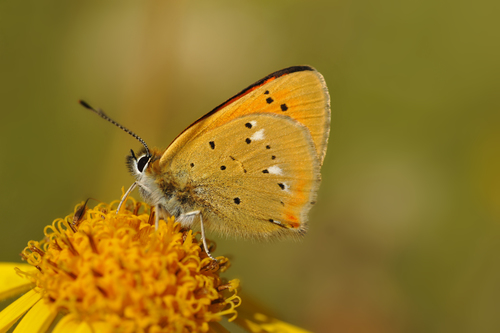
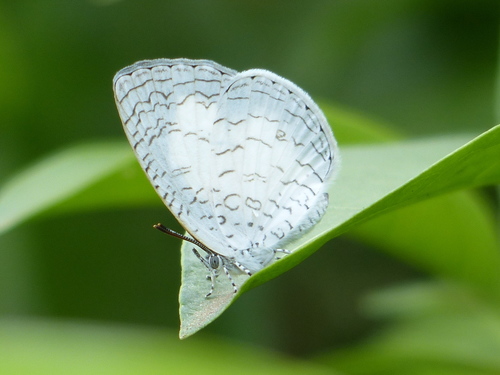
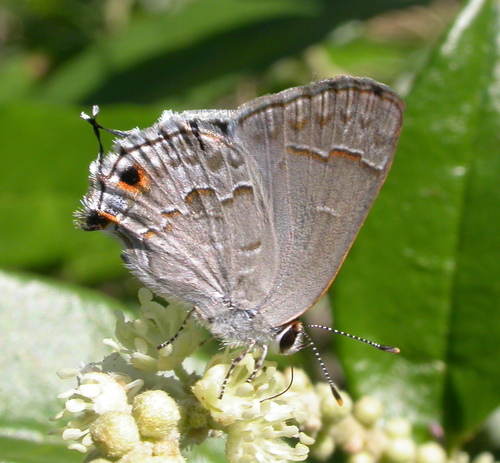
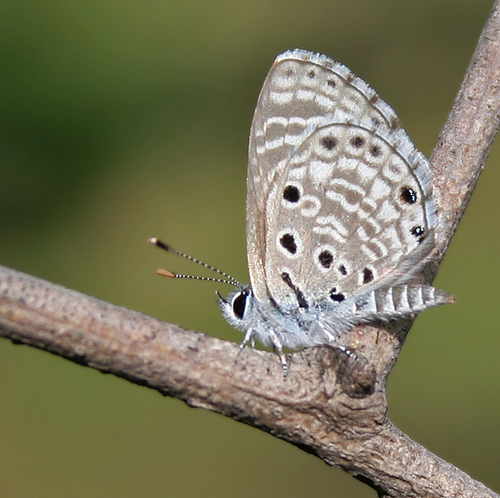
This species is Azanus jesous, first described by Guérin-Méneville in 1847. For male individuals: The upperside is a paler, much brighter purple than that of Azanus ubaldus, with a more pronounced dark blue tint at the base of the wings. The forewing lacks the layer of specialized hair-like scales that are prominent in A. ubaldus. The hindwing has very obscure dark tornal spots. Both forewings and hindwings only have slender dark anteciliary lines, with no regular brown edging. The underside is dull pale grey. On the forewing, the costal margin is brown, with a black spot encircled by white in the cell, and a dark chestnut-brown streak between vein 12 and the subcostal vein. Similarly colored, somewhat paler transverse bars cross the upper discal area of the wing: one on the discocellulars and three beyond, with each bar edged with white on its inner and outer sides. Below these bars are two elongate, brownish, white-edged spots arranged en echelon, and beyond these is a slender, unbroken, transverse, postdiscal brown line. There is also a transverse subterminal series of black spots, each surrounded by white, plus a slender dark anteciliary line. Most specimens also have a dusky spot below the cell near the wing base. On the hindwing, a short outwardly oblique streak runs from the base of the cell, there is one spot below this streak, a transverse subbasal series of four spots, and a complete series of subterminal spots in interspaces 1, 2, 4, 5, 6, and 7; all of these markings are jet-black and each spot is surrounded by white. The subterminal spot in interspace 3, a small terminal spot in interspace 7, an outwardly-oblique discal line of six elongate spots (with the anterior spot shifted inward out of alignment), and a transverse line beyond the apex of the cell are dark brown, and each of these markings is margined with white. On the terminal area, there is an inner subterminal lunulated dark line on the inner side of the series of black spots, plus a similar slender anteciliary line. The cilia are white, with brown basal halves; on the forewing, the cilia are also interrupted with brown at the apices of the veins. The antennae, head, thorax, and abdomen are dark brown; the shafts of the antennae are ringed with white, the thorax has a small amount of bluish pubescence. On the underside, the palpi, thorax, and abdomen are white. For female individuals: The upperside is milky brown, with a bluish tint at the base of the wings. The forewing has a large dark brown transverse discocellular spot and a small quadrate white patch beyond it. The hindwing has two or three obscure dark subterminal spots toward the tornus. In some specimens, the subterminal spot series is complete from apex to tornus, and is more obscure in the anterior portion than in the posterior. Both forewings and hindwings have a slender dark anteciliary line. The underside has a slightly paler ground color, but the markings are very similar to those of the male; on the forewing, the transverse brown bars beyond the apex of the cell are longer, and almost extend to the dorsal margin. The cilia, antennae, thorax, and abdomen are much the same as in the male.