About Azadirachta indica A.Juss.
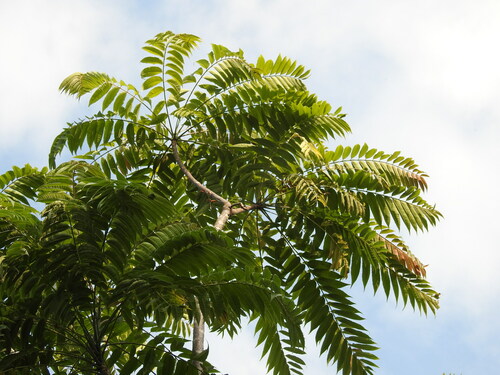
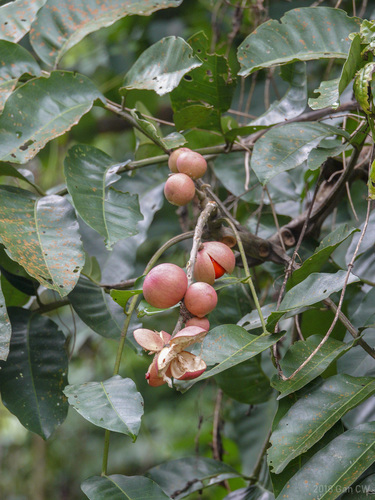
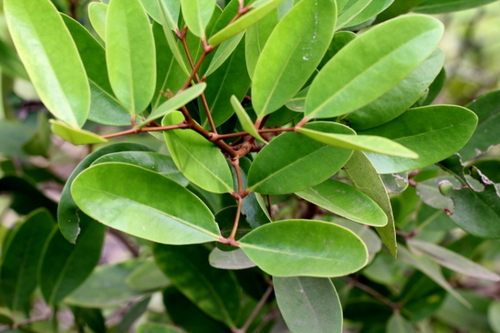
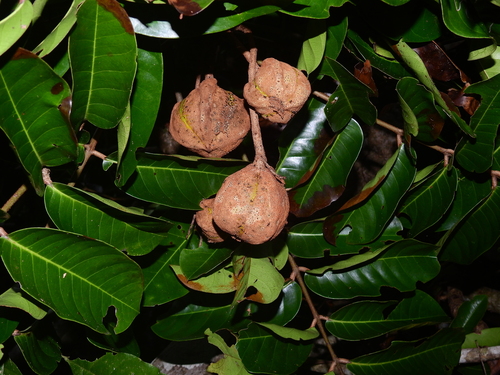
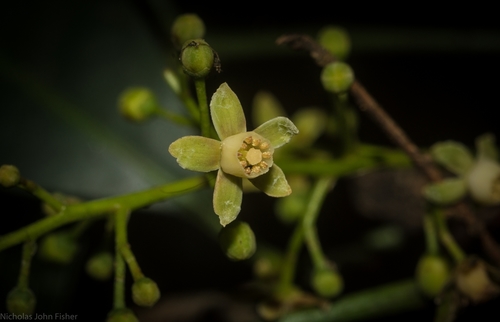
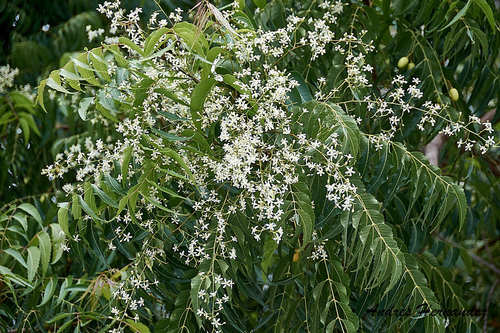
Azadirachta indica A.Juss., commonly known as neem or margosa, is a fast-growing evergreen tree that normally reaches 15–20 metres (49–66 ft) in height, and rarely grows to 35–40 m (115–131 ft). While classified as evergreen, it sheds many of its leaves during dry winter months. It has wide, spreading branches and a fairly dense, roundish crown that can reach 20–25 m (66–82 ft) in diameter. Its leaves are opposite and pinnate, measuring 20–40 cm (8–16 in) in total length, and hold 20 to 30 medium to dark green leaflets that are each 3–8 cm (1+1⁄4–3+1⁄4 in) long. The terminal leaflet is often missing, and leaf petioles are short. White, fragrant flowers grow in more-or-less drooping axillary panicles up to 25 cm (10 in) long. These inflorescences, which branch up to the third degree, carry 250 to 300 individual flowers. Each individual flower is 5–6 mm (3⁄16–1⁄4 in) long and 8–11 mm (5⁄16–7⁄16 in) wide. Neem is monoecious: it produces both protandrous bisexual flowers and male flowers on a single individual tree. Its fruit is a smooth (glabrous) olive-like drupe that ranges in shape from elongated oval to nearly roundish. When ripe, the fruit measures 14–28 mm (1⁄2–1+1⁄8 in) by 10–15 mm (3⁄8–5⁄8 in). The thin outer fruit skin (exocarp) surrounds a bitter-sweet, yellowish-white, very fibrous pulp (mesocarp) that is 3–5 mm (1⁄8–1⁄4 in) thick. A hard, white inner shell (endocarp) encloses one, or rarely two or three, elongated seeds (kernels) that have a brown seed coat. Neem resembles its close relative Melia azedarach, also known as chinaberry or bakain, and the two are often confused. Melia azedarach also has toothed leaflets and similar-looking fruit. A key distinguishing feature is that neem leaves are simply pinnate, while chinaberry leaves are twice- or thrice-pinnate. Azadirachta indica is considered native to the Assam region, Pakistan, and Bangladesh in the Indian subcontinent, and to Cambodia, Laos, Myanmar, Thailand, and Vietnam in Indochina. It has been widely introduced to other tropical and subtropical regions across the globe, ranging from South America to Indonesia. Neem is well known for its drought resistance. It normally grows best in areas with sub-arid to sub-humid conditions that receive 400–1,200 mm (16–47 in) of annual rainfall. It can grow in regions with less than 400 mm of annual rainfall, but in these cases it depends heavily on accessible groundwater. It can grow in a wide variety of soil types, but thrives best in deep, well-drained sandy soils. As a typical tropical to subtropical species, it grows in areas with annual mean temperatures of 21–32 °C (70–90 °F). It tolerates high to very high temperatures, but cannot survive temperatures below 5 °C (41 °F). Neem is one of the few shade-providing tree species that thrive in drought-prone areas, such as the dry coastal southern districts of India and Pakistan. The species is not sensitive to water quality, and grows well with only minimal water input regardless of water quality. In India and many tropical regions reached by the Indian diaspora, neem trees are commonly planted as shade trees along streets, around temples, schools, and other public buildings, and in most residential backyards. In very dry areas, neem is planted across large tracts of land. Dried neem leaves are used in India, placed in cupboards to protect clothing from insect damage, and added to grain storage containers for rice and wheat. Neem flowers are used in many Indian festivals, including Ugadi. Neem products have been used in Indian traditional medicine for centuries, but there is insufficient clinical evidence to confirm any medicinal benefits from neem use. Neem oil is toxic to small children and can cause death. Neem may also cause miscarriages, infertility, and low blood sugar. In Southern India and the Middle East, neem twigs are traditionally used as teeth-cleaning tools. The neem tree is valued for its anti-desertification properties, and is thought to be a good carbon dioxide sink. It is also used to maintain soil fertility. Neem extract is added to urea-based fertilizers to act as a nitrification inhibitor. Neem leaves can occasionally be used as forage for ruminants and rabbits.