About Aythya marila (Linnaeus, 1761)
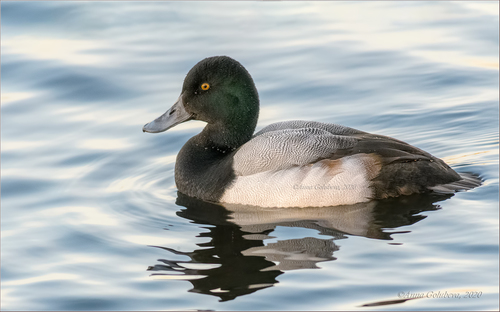
Adult greater scaup (Aythya marila) measure 39–56 cm (15–22 in) in length, have a 71–84 cm (28–33 in) wingspan, and weigh 726–1,360 g (1.601–2.998 lb). They have a light blue bill with a small black tip nail and yellow eyes, and are 20% heavier and 10% longer than the closely related lesser scaup. Males have a dark head with a green to purple sheen, black breast, light back, black tail, and white underside. Males are larger with a more rounded head than females, and their bellies and flanks are bright white. Their neck, breast, and tail feathers are glossy black, while their lower flanks are vermiculated grey. A white stripe on the upper wing starts as the speculum and extends along the flight feathers to the wingtip. The legs and feet of both sexes are grey. Adult females have a brown body and brown head, with white wing markings similar to males but slightly duller. They have a white band and brown oval-shaped patches at the base of the bill, which is a slightly duller blue than the male's bill. Juvenile greater scaup look similar to adult females. Male eclipse plumage looks similar to breeding plumage, except the pale areas of the plumage are a buffy grey. Distinguishing greater scaup from lesser scaup can be difficult in the field. Greater scaup typically have a more rounded head, a more extensive white wing stripe, a larger wider bill, and a slightly larger black tip nail than lesser scaup. The North American subspecies A. m. nearctica typically has a higher forehead and reduced white on the wings, and is intermediate between the European nominate subspecies A. m. marila and the lesser scaup. Greater scaup has a circumpolar distribution, breeding within the Arctic Circle in both the Old World Palearctic and North American Nearctic. It spends the summer in Iceland, east across Scandinavia, northern Russia and Siberia, Alaska, and northern Canada. It is mostly migratory, but small numbers stay in Iceland and the Aleutian Islands year-round. Its summer habitat is marshy lowland tundra and islands in freshwater lakes. In autumn, greater scaup migrate south to winter. They winter along the Pacific and Atlantic coasts of North America, the coasts of northwest Europe, the Caspian Sea, the Black Sea, the coast of Japan, the Yellow Sea, and the East China Sea. During winter, they live in coastal bays, estuaries, and sometimes inland lakes, such as the lakes of Central Europe and the Great Lakes. In Europe, greater scaup breeds in Iceland, the northern coasts of the Scandinavian Peninsula (including much of the northern parts of the Baltic Sea), the higher mountains of Scandinavia, and areas near the Arctic Sea in Russia. It has also bred sporadically in northern Scotland. European wintering grounds include the British Isles, western Norway, the southern tip of Sweden, the coast from Brittany to Poland (including all of Denmark), the Alps, the eastern Adriatic Sea, the northern and western Black Sea, and the southwestern Caspian Sea. In North America, greater scaup spends the summer in Newfoundland and Labrador, Ungava Bay, Hudson Bay, Lake Winnipeg, northern Yukon, northern Manitoba, and northern Saskatchewan. It winters along the coasts of North America from northern British Columbia south to the Baja Peninsula, from Nova Scotia and New Brunswick south to Florida, as well as on the shores of the Great Lakes and the Gulf of Mexico.