About Aythya fuligula (Linnaeus, 1758)
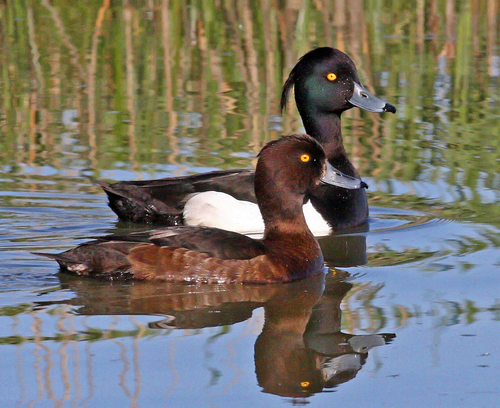
This species, the tufted duck, has the scientific name Aythya fuligula (Linnaeus, 1758). Adult males are entirely black aside from white flanks, a blue-grey bill, and golden yellow eyes, with a thin crest on the back of the head. The prominent head tuft is the source of the species' common name. Adult females are brown with paler flanks, and are easily confused with other species of diving duck. Some females have white markings around the base of the bill that look similar to markings seen on scaup species, though the white on female tufted ducks never covers as much area as it does on scaup. Females produce a harsh, growling call "karr", most often given when in flight. Males are mostly silent, but whistle a simple "wit-oo" during courtship. Greater scaup and lesser scaup are the only ducks similar in appearance to tufted ducks; however, neither scaup species have the tuft, and both produce different calls. The tufted duck is one of the species covered by the Agreement on the Conservation of African-Eurasian Migratory Waterbirds, or AEWA. Tufted ducks breed across temperate and northern Eurasia. They occasionally appear as winter visitors along both the Atlantic and Pacific coasts of the United States and Canada. The species is believed to have expanded its traditional range, due to increased availability of open water from gravel extraction and the spread of freshwater mussels, which are a favorite food of the tufted duck. Most populations of tufted ducks are migratory, overwintering in the milder southern and western regions of Europe, and in southern Asia. Populations remain in the British Isles year-round. A single individual has even been recorded as far south as Melbourne, Australia. In winter, tufted ducks form large flocks on open water. Their breeding habitat is located near marshes and lakes that have abundant vegetation to hide their nests. They can also be found on coastal lagoons, shorelines, and sheltered ponds. Tufted ducks feed mainly by diving, but will sometimes upend from the water surface. Their diet consists of molluscs, aquatic insects, and some plant material, and they sometimes feed at night.