About Aythya australis (Eyton, 1838)
Hardheads, also known by the scientific name Aythya australis (Eyton, 1838), are smaller than most duck species. Their typical body length ranges from 42 to 59 cm (17 to 23 in), and both sexes share similar sizes, with body weights falling between 525 and 1,100 g (18.5 to 38.8 oz) and wingspans measuring 65 to 70 cm (26 to 28 in).
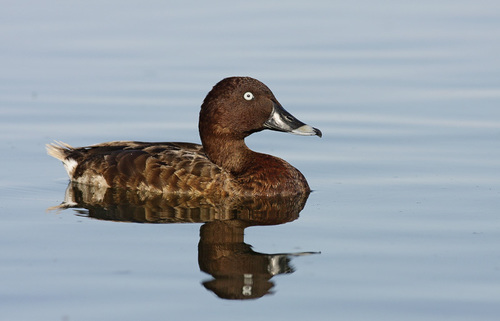
Both males and females have fairly uniform chocolate-brown plumage on their upper bodies, paired with rufous flanks and white undersides; the white undersides are often hidden from view when the duck is in the water. The trailing edges of the wings and almost the entire underside of the wings are white. Males have distinctive striking white eyes, while females have brown eyes.
Hardheads are common in south-eastern Australia, especially in the Murray-Darling Basin, and also occur in wetter coastal areas. In average years they are moderately nomadic, but they disperse over wide distances during periods of drought. Significant numbers of hardheads travel as far as New Guinea, New Zealand, and the Pacific islands, where they can stay for extended periods, even breeding for one to two seasons.
Hardheads prefer larger lakes, swamps, and rivers with deep, still water, but they are also frequently spotted in smaller streams, flooded grasslands, and shallow pools. As a general rule, they avoid coastal waters. They rarely come ashore and never perch in trees. Since the species is widespread across its large range, the hardhead is currently classified as Least Concern on the IUCN Red List of Threatened Species.