About Aythya affinis (Eyton, 1838)
Adult lesser scaup (Aythya affinis) measure 38–48 cm (15–19 in) in total length, with an average length of 41.7–43 cm (16.4–16.9 in). Their body weight ranges from 454–1,089 g (1.001–2.401 lb); males average 820 g (1.81 lb), while females are noticeably lighter at an average 730 g (1.61 lb). Wing length (not wingspan) measures approximately 7.5–7.9 in (19–20 cm) for males and 7.3–7.8 in (19–20 cm) for females. The tarsus is around 1.4–1.5 in (3.6–3.8 cm) long, the bill is 1.4–1.7 in (3.6–4.3 cm) long, and the wingspan ranges from 68–78 cm (27–31 in).
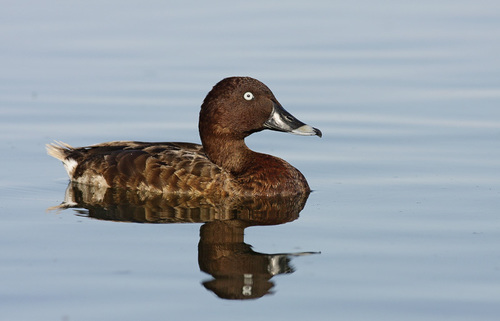
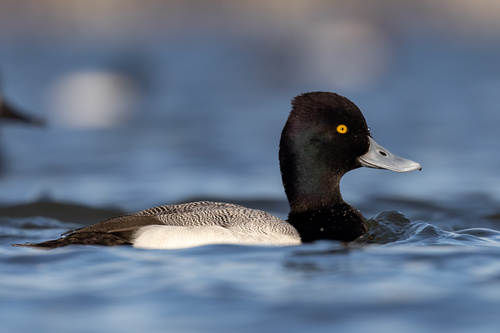
Adult breeding (definitive basic plumage) males (drakes) have a black iridescent head with a small tuft at the hindcrown, a black breast, and a whitish-grey back. Their wings have darker vermiculations, black outer primary remiges, and greyish-brown inner primary remiges. The underparts are white with some olive vermiculations on the flanks, and both rectrices and tail coverts are black. Adult females (hens) have a white band at the base of the bill, often a lighter ear region, are dark brown across most of the body, and shade to white on the mid-belly. Drakes in eclipse plumage resemble adult females, but have a very dark head and breast, little to no white on the head, and usually some greyish vermiculations on the wings. Immature birds also resemble adult females, but are duller and have almost no white at the bill base.
Both sexes have white secondary remiges, a blue-grey bill with a small black "nail" at the tip, and grey feet. Drakes have a bright yellow iris, females have an orange to yellow iris that varies with age, and immatures have a brown iris. Downy hatchlings closely resemble hatchlings of related species, with dark brown upperparts, and pale buff underparts, chin, supercilium, and back spots.
Compared to dabbling ducks, lesser scaup are not very vocal. Hens produce the namesake discordant "scaup, scaup" call, while courting drakes make weak whistles. Hens vocalize more often than female greater scaup, particularly during flight, but their call is weaker: a guttural brrtt, brrtt.
Lesser scaup are often difficult to distinguish from greater scaup when the two species cannot be directly compared, though large scaup flocks in North America usually contain both species. Females, juveniles, and eclipse-plumage drakes are especially hard to identify. While there is considerable overlap in body length between the two species, greater scaup are typically noticeably more bulky. Lesser scaup females and immatures usually have less white around the bill, though this trait varies widely between individual birds. Generally, lesser scaup have a smaller, straighter bill with a relatively narrow profile, while greater scaup have a wider, more spatulate bill toward the tip. The dark nail at the bill tip is also on average wider in greater scaup.
In flight, the most reliable identifying feature is the extent of white on the wings: lesser scaup only have white on their secondary remiges, while greater scaup have white that extends onto the primary remiges, all the way to the wingtip. Breeding-plumage lesser scaup drakes are often said to be distinguishable by a purple rather than green head sheen and a darker back, but this trait is unreliable because it changes with light conditions, and the birds are often too far from observers to see any sheen at all.
Head shape is a key identifying difference, only visible when birds are at rest and not actively diving. Breeding-plumage greater scaup drakes, especially in North American and East Asian populations, usually have a quite massive forehead, with a smooth shallow, often almost straightly sloping nape. Breeding-plumage lesser scaup drakes have the opposite shape: a less bulging forehead and a nape that looks strongly curved or even angular due to the small crest. These differences are easiest to spot when the birds raise their heads, and become simple to recognize after direct comparison of the two species. Basic-plumage lesser scaup drakes may appear identical in shape and size to ring-necked duck (A. collaris) drakes, but the black back and wings of ring-necked ducks are easily distinguished from the lighter back and wings of male lesser scaup.
Lesser scaup breed on inland lakes and arctic marsh ponds, ranging from Alaska through western Canada to western Montana; very few breed east of James Bay and the Great Lakes. Notable breeding concentrations, holding more than half a million birds at the height of the breeding season, occur in Alaska, the woodlands of the McKenzie River valley, and on the Old Crow Flats. After the young fledge, the birds migrate south, mostly via the Central and Mississippi Flyways, and return to breeding grounds in early spring, usually arriving in May. Lesser scaup typically travel in flocks of 25–50 birds, and winter mainly on lakes, rivers, and sheltered coastal lagoons and bays between the U.S.-Canada border and northern Colombia, including Central America, the West Indies, and Bermuda.
Wintering lesser scaup usually occupy freshwater or slightly brackish habitat, and unlike greater scaup, they are rarely found offshore when unfrozen freshwater habitat is available. They may even winter on park lakes if not disturbed, and can occur on small Caribbean islands such as Grand Cayman. Thousands winter each year on the Topolobampo lagoons in Mexico, and even at the southernmost major wintering location, Ciénaga Grande de Santa Marta in Colombia, hundreds of birds can be found. In Central America, flocks are present from July, but only become numerous after September, and the birds move north again in April and May. At the extreme southeast and southwest edges of the breeding range, the Rocky Mountains region of the northwestern United States and the southern Great Lakes, lesser scaup are present year-round; it is unclear whether local breeding birds are replaced by far northern migrants in winter, local populations do not migrate, or both local and migrant birds are present there in winter.
Lesser scaup are rare vagrants in western Europe, but sightings there are apparently becoming increasingly common. The first documented British record was a first-winter male at Chasewater, Staffordshire in 1987; by 2006, over 60 had been recorded, with an average of 2 per year. UK records are typically from the northern parts of the country. Vagrant lesser scaup have also been recorded on the Hawaiian Islands, Japan, possibly China, and (for the first time on 18 January 2000) in the Marianas, as well as in Ecuador, Suriname, French Guiana, Trinidad, Venezuela (in winter), and Greenland (in summer).
Lesser scaup forage mainly by sifting through bottom mud, most often after diving and swimming underwater, and only occasionally dabble without diving. They primarily eat mollusks such as mussels and clams, plus seeds and other plant parts from aquatic species including sedges and bulrushes (Cyperaceae), pondweeds, widgeon-grass (Ruppia cirrhosa), wild celery (Vallisneria americana), and wild rice (Zizania). In winter, aquatic animals (crustaceans, insects and their larvae, and small fish) form an important part of their diet; this is less common in summer. It has been reported that both lesser and greater scaup have shifted their traditional migration routes to use the abundant zebra mussel (Dreissena polymorpha) population of Lake Erie. Zebra mussels were accidentally introduced to the lake in the 1980s and have multiplied enormously, but this new food source may pose a risk to the ducks because zebra mussels are efficient filter feeders that rapidly accumulate environmental contaminants.
Lesser scaup nest in sheltered locations on the ground near water, usually among thick vegetation such as sedges and bulrushes. They sometimes nest in small loose groups, and often nest next to gull or tern colonies; several females may lay eggs in a single nest. Drakes court hens on the wintering grounds, and pairs form shortly before and during spring migration. When nesting begins, males aggregate while they moult into eclipse plumage, leaving incubation and raising young entirely to females. The nest is a shallow depression scraped into the ground, lined with plants and some down feathers.
Breeding activity begins in May, but most birds do not nest until June, later than is typical for North American waterfowl. The average clutch size is 9–11 eggs; up to 26 eggs have been found in a single nest, but such high counts come from multiple females laying in one nest. Only the female incubates eggs, which takes around 3 weeks. The young fledge 45–50 days after hatching, and the birds soon migrate to wintering grounds. Lesser scaup reach sexual maturity in their first or second summer. The oldest known individual lived to over 18 years of age. Before the current population decline began, around 57% of lesser scaup nests failed each breeding season due to death of the female or loss of eggs to predation or destruction. The average brood size for successfully hatched nests was 8.33 hatchlings.