About Axis porcinus (Zimmermann, 1780)
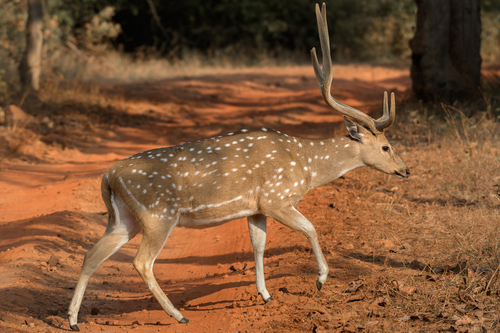
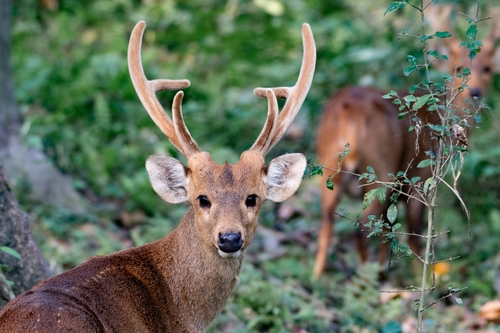
Mature male hog deer (stags) stand around 70 centimeters (28 inches) at the shoulder and weigh approximately 50 kilograms (110 pounds). Female hog deer (hinds) are much smaller, standing around 61 centimeters (24 inches) and weighing roughly 30 kilograms (66 pounds). This species is very solidly built, with a long body and relatively short legs. The line of the back slopes upward from the shoulders to a high rump, and the ears are rounded. Older individuals typically develop lighter coloration on the face and neck. The Indian hog deer has a quite thick coat, which is generally a uniform dark brown in winter, with lighter coloration on the underparts of the body and legs. In late spring, individuals begin to molt into a rich reddish-brown summer coat, though the timing of this change can vary between individuals. Many hog deer have a dark dorsal stripe that runs from the head down the back of the neck and along the spine. In summer, a uniform row of light-colored spots usually appears along either side of the dorsal stripe, extending from the shoulders to the rump. The tail is fairly short and brown, with a white tip. The underside of the tail is also white, and the deer can fan out these white hairs as a distinctive alarm display. The antlers of a mature stag are typically three-tined: they have a brow tine and a solid main beam that ends in inner and outer top tines. Antlers with more than three points are not uncommon for this species. The Indian hog deer is native to the Indus River valley in Pakistan, northern India, Nepal, southern Bhutan, Bangladesh, Myanmar, and China’s Yunnan Province. It has been reintroduced to Thailand, but is locally extinct in Laos and Vietnam. A small, isolated population of Indian hog deer lives in Cambodia’s Prek Prasab Wildlife Sanctuary. Known predators of the Indian hog deer include tiger, leopard, clouded leopard, Burmese python, and dhole.