About Axis axis (Erxleben, 1777)
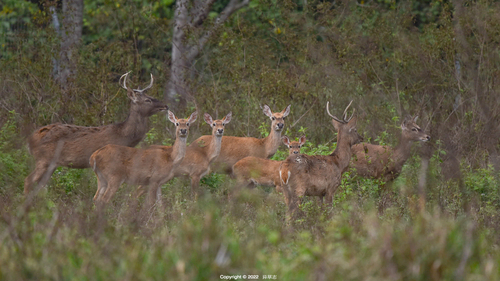
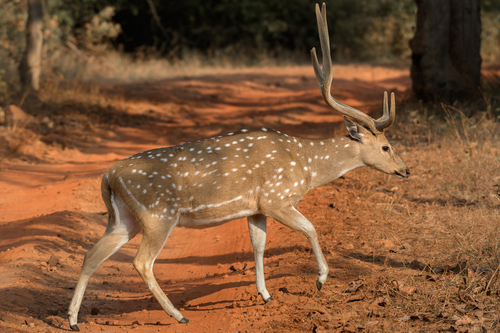
The chital, scientifically known as Axis axis (Erxleben, 1777), is a moderately sized deer that shows clear sexual dimorphism: males are larger than females, and only males grow antlers. Males stand 90–100 cm (35–39 in) tall at the shoulder, while females reach 65–75 cm (26–30 in). The total head-and-body length of chital is around 1.7 m (5 ft 7 in). Immature males weigh 30–75 kg (66–165 lb), females weigh 25–45 kg (55–99 lb), and mature stags can weigh up to 98–110 kg (216–243 lb). The 20 cm (7.9 in) long tail has a dark stripe running along its entire length. The upper (dorsal) body is golden to rufous, fully covered in white spots. The abdomen, rump, throat, inner surfaces of the legs, inner ears, and tail underside are all white, and a distinct black stripe runs along the spine. Chital have well-developed preorbital glands near the eyes, which have stiff hairs and are larger in males than in females; preorbital glands are often opened in response to certain stimuli. They also have well-developed metatarsal glands and pedal glands in their hind legs. Male antlers are three-pronged and nearly 1 m (3 ft 3 in) long. Each antler has three tines, and the brow tine (the first division of the antler) is roughly perpendicular to the central antler beam. Like most cervids, chital shed their antlers annually. New antlers first emerge as soft velvet antlers, then gradually harden into bony hard antlers through mineralization and blood vessel blockage, progressing from the tip to the base. A study comparing the antler mineral composition of captive barasingha, chital, and hog deer found that the antlers of the three species are very similar. For chital antlers, mineral content per kilogram was measured as 6.1 mg (0.094 gr) copper, 8.04 mg (0.1241 gr) cobalt, and 32.14 mg (0.4960 gr) zinc. Chital hooves measure 4.1 to 6.1 cm (1.6 to 2.4 in) in length, with foreleg hooves longer than hindleg hooves, and toes taper to a point. The chital's dental formula is 0.1.3.3/3.1.3.3, which matches that of elk. The milk canine, which is nearly 1 cm (0.39 in) long, falls out before the chital reaches one year of age, and is not replaced by a permanent tooth unlike in other cervids. Compared to hog deer, chital have a more cursorial build. Their antlers and brow tines are longer than those of hog deer, while their antler pedicles (the bony cores that support antlers) and auditory bullae are shorter and smaller, respectively. Chital are often confused with fallow deer, but they can be easily distinguished: chital have many small white spots, while fallow deer usually have white splotches; fallow deer have palmate antlers, while chital have three distinct points per antler; chital have a prominent white patch on the throat, while fallow deer have an entirely white throat; and chital have a distinct dark stripe running down their back, which fallow deer lack. Chital hairs are smooth and flexible. The chital's native range falls between 8–30°N, across India, Nepal, Bhutan, Bangladesh and Sri Lanka. The western edge of its range is eastern Rajasthan and Gujarat; the northern edge is the Terai, northern West Bengal, Sikkim to western Assam, and forested valleys of Bhutan below 1,100 m (3,600 ft). It occurs in the Sundarbans and some eco parks around the Bay of Bengal, but is locally extinct in central and north-eastern Bangladesh. Its southern range limits are the Andaman and Nicobar Islands and Sri Lanka. Throughout the Indian peninsula, it inhabits deciduous and semi-evergreen forests and open grasslands. Chital are active throughout the day. In summer, they rest in shade to avoid the sun's glare when temperatures reach 27 °C (80 °F), and activity peaks as dusk approaches. In cooler weather, foraging starts before sunrise and peaks in early morning, activity slows during midday when they rest or move slowly, and foraging resumes in late afternoon and continues until midnight. They sleep a few hours before sunrise, typically in cooler forest rather than open glades. When traveling to find food and water, chital usually move in single file along specific tracks, with a gap of two to three times their body width between individuals. In Gir National Park, chital travel more in summer than in any other season. When carefully checking their surroundings, chital stand motionless and listen closely, facing any potential danger; nearby individuals may also take this stance. As an anti-predator adaptation, chital flee in groups when alarmed, unlike hog deer which disperse. After sprinting, they usually hide in dense undergrowth. When running, chital raise their tails to expose the white underparts. Chital can leap over fences up to 1.5 m (4 ft 11 in) high, but prefer to dive under fences instead. They generally stay within 300 m (980 ft) of cover. Chital form loose matriarchal herds that include an adult female, her offspring from the previous and current year, and other individuals of any age or sex. Small herds are most common, though groups of up to 100 individuals have been recorded. Herds disband frequently, except for the core juvenile-mother unit. In Texas, chital herds have up to 15 members; in the Nallamala Hills, large herds of up to 40 members have been observed in grasslands during the monsoon. Herd sex ratio varies seasonally, because females tend to isolate before giving birth, and rutting males leave their herds during the mating season, both altering herd composition. Predators of adult chital include Indian wolves, tigers, Asiatic lions, leopards, pythons, dholes, Indian pariah dogs, and crocodiles. Juveniles are additionally targeted by fishing cats, jungle cats, foxes, golden jackals and eagles. Adult males are less vulnerable to predation than females and juveniles. Chital are vocal animals, similar to North American elk. They produce bellows and alarm barks, though their calls are not as loud as those of elk or red deer; their calls are mostly coarse bellows or loud growls. Bellowing occurs during the rut. Dominant males guarding oestrous females emit high-pitched growls toward less dominant males. Males may moan during aggressive displays or while resting. Females and juveniles, in particular, bark repeatedly when alarmed or when they encounter a predator. Fawns looking for their mother often squeal. Chital can respond to alarm calls from other animals, including common mynas and langurs. Marking behavior is prominent in males. Males stand on their hind legs to reach tall branches, then rub their open preorbital glands on the branches to deposit their scent; this posture is also used while foraging. Urine marking is also seen, and urine has a stronger scent than the gland marking. Sparring between males starts with the larger male displaying dominance: this display includes hissing, walking away from the other male with the tail facing the opponent, nose pointing to the ground, ears lowered, antlers upright, and the upper lip raised. The fur typically bristles during this display. The male then approaches the opponent slowly. Males with velvet antlers may hunch over instead of standing upright like males with hard antlers. Opponents then interlock their antlers and push against each other. The smaller male sometimes produces a sound that is louder than sambar deer calls, but quieter than barasingha calls. Fights end when males step back, or simply leave to forage. Fights are not generally serious, though individuals may occasionally bite each other. Common mynas are often attracted to chital. A mutualistic relationship has been observed between chital herds and troops of northern plains grey langurs: chital gain protection from langurs' sharp eyesight and tree-top lookout positions, while langurs benefit from chital's strong sense of smell, and both gain improved detection of potential danger. Chital also benefit from fruits dropped by langurs from trees such as Terminalia bellirica and Phyllanthus emblica. Chital have been observed foraging alongside sambar deer in the Western Ghats. Breeding occurs year-round, with seasonal peaks that differ by geographic location. Males produce sperm year-round, but testosterone levels drop while new antlers are developing. Females have regular three-week oestrus cycles, and can conceive again 2 to 16 weeks after giving birth. Males with hard antlers are dominant over males with velvet antlers or no antlers, regardless of their body size. Courtship follows a tending bond system: a rutting male fasts during the mating season while following and guarding a female in oestrus. The pair engages in multiple bouts of chasing and mutual grooming before copulation. Newborn fawns stay hidden for one week after birth, a much shorter period than most other deer. The mother-fawn bond is not very strong, and the two separate often, but they can easily reunite because herds stay cohesive. If a fawn dies, the mother can breed again to give birth twice in the same year. Males continue growing until they are seven to eight years old. The average lifespan of chital in captivity is almost 22 years. In the wild, longevity is only five to ten years due to predation and competition.