About Aviceda subcristata (Gould, 1838)
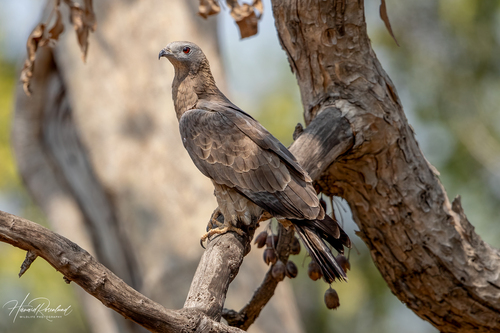
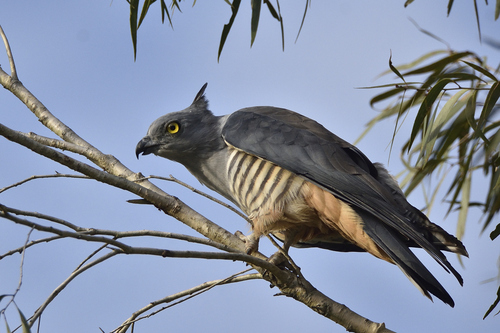
The Pacific baza (scientific name Aviceda subcristata (Gould, 1838)) is a slender, medium-sized raptor with a slim head and neck, and it shares a similar general appearance with other species in its genus. Adults reach a total length of 35–46 centimetres (14–18 in), with a wingspan of 80–105 centimetres (31–41 in), a tail length of 19–23 centimetres (7.5–9.1 in), and a body weight of 260–450 grams (9.2–15.9 oz); females are slightly heavier than males. Individuals from the extreme western and eastern ends of the species' range are typically smaller than those from other areas. This species has a white underside barred with black, a grey upperside, and brown scapular feathers. Its head is grey, proportionally small, and partially domed, with round yellow eyes set far back on the sides of the head. The thighs are reddish-brown, and the feet are grey. Dark bands on the primary flight feathers (fingers) are visible when the bird soars in circles. It is the only crested raptor found in New Guinea, bearing a small, spiky crest on the nape. Its wings are broad, rounded, and paddle-shaped with distinct bands, and they are very large relative to the bird's body. Wings are narrowest at the body attachment, widening toward the tips, and the wing edges are curved during flight. The Pacific baza has a long square-tipped tail that is colored black at the tip, and the tail matches the length of the rest of the bird's body. Females can be told apart from males by their slightly browner upperside and sometimes more extensive barring on secondary flight feathers. Juveniles differ from adults by their much browner upperside, pale eyes (instead of the adult's bright yellow eyes), patterned face, reduced belly barring, rust-colored breast, white throat, and a cream to blue-grey cere. This species can be distinguished from the similar-looking long-tailed honey buzzard (Henicopernis longicauda) by its less rounded wings and barred (rather than streaked) breast. The Pacific baza occurs across warmer, humid areas of the Australasian realm; it breeds in Australia, Indonesia, Papua New Guinea, Solomon Islands, and South Africa, and is a resident species in East Timor. In Australia, it only occurs in areas within 400 kilometres (250 mi) of the coast, primarily in the northern and eastern parts of the country. The species' total extent of occurrence is estimated to be 11,100,000 square kilometres (1.11×10¹³ m²). Its habitats include subtropical and tropical forests, dry savannas, and freshwater environments such as wetlands, streams, and rivers; it is usually found at elevations below 1,000 metres (3,300 ft), and rarely occurs above 1,300 metres (4,300 ft). It is used in the international pet trade. As of 2016, it is listed as a species of Least Concern on the IUCN Red List due to its large range and stable population.