About Averrhoa carambola L.
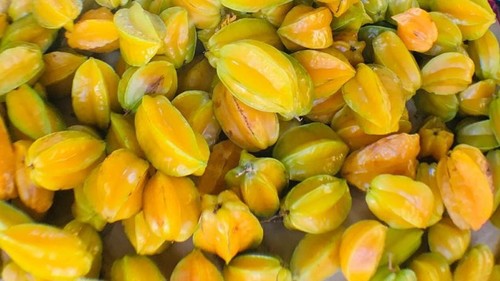
Averrhoa carambola L. is a small, slow-growing evergreen that grows as either a short-trunked tree or a shrub. It has drooping branches, white wood that turns reddish with age, and a bushy growth habit that forms a broad, rounded crown from its many branches. Its soft, medium-green compound leaves are arranged alternately in a spiral pattern along branches. These pinnate leaves feature a single terminal leaflet plus 5 to 11 nearly opposite leaflets, and the full leaf measures 15–20 cm long. Individual leaflets are 3.8–9 cm long, with an ovate or ovate-oblong shape. The upper surface of leaflets is smooth, while the undersides are finely hairy and whitish. Leaflets are light-reactive, and fold together at night; they are also sensitive to sudden shock, and close up when shaken. Lilac or purple-streaked, downy flowers grow from the leaf axils at the ends of twigs. Flowers form small clusters at branch ends, or sometimes on larger stems and the trunk, and each cluster connects to the tree via red stalks. These are bell-shaped, perfect flowers that grow in loose, much-branched panicles, with each flower attached by a stalk. Individual flowers are around 6 mm wide, with five petals that have recurved ends. The species produces showy oblong fruits that are 5 to 6 longitudinally angled, 6.35–15 cm long, and up to 9 cm wide. Fruits have thin, waxy, orange-yellow skin. When ripe, the juicy flesh is yellow inside, with a crisp texture, and the fruit is characteristically star-shaped when cut cross-sectionally. Fruits give off an oxalic acid odor that ranges from strong to mild between individual plants, and fruit taste also ranges from very sour to mildly sweetish. Each fruit can hold up to twelve flat, thin, brown seeds that measure 6–12.5 mm long. Some cultivated varieties of Averrhoa carambola produce seedless fruits. Tropical Southeast Asia is the center of diversity and original range of Averrhoa carambola, where it has been cultivated since ancient times. While it is native to Southeast Asia, the species is not found in the wild, so it is difficult to pinpoint its exact original origin. It may have been introduced to the Indian subcontinent and Sri Lanka by Austronesian traders, alongside other ancient Austronesian cultigens like langsat and santol. Averrhoa carambola is most widely known as star fruit, named for the star-like shape of its cut fruit. In addition to being eaten, the fruit is used in traditional Asian medicine to treat chickenpox, intestinal parasites, headaches, and other illnesses. Star fruit contains oxalate, and consuming too much oxalate can be dangerous. Star fruit juice can also be used to remove stains from linen. Averrhoa carambola has multiple cultivated forms that differ in fruit taste, texture, and shape, with some being very acidic and others sweet. It is grown commercially for its edible fruit. Major growing regions include Malaysia and Taiwan, with smaller production areas in Thailand, Israel, the United States, Brazil, the Philippines, China, Australia, Indonesia, the warmer parts of India, and other regions across the world with a matching tropical climate. Flowers require cross-pollination to produce fruit, so plants grown from seed have variable characteristics. Plants grown from seed can flower and bear fruit around one year after germination. In tropical regions with suitable environmental conditions, larger plants can bloom year-round, and may carry flowers, unripe fruit, and ripe fruit at the same time. In other climate conditions, plants typically bloom in spring, then flower intermittently for the rest of the year. Many different cultivars are grown, most selected to improve fruit flavor and maximize fruit production for specific growing regions, with each country or region developing its own specific cultivar selections.