About Averrhoa bilimbi L.
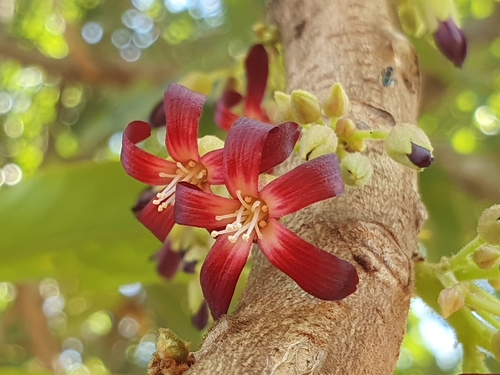
Averrhoa bilimbi L. is a small tropical tree that can reach up to 15 meters in height. It often grows multiple trunks that quickly branch into smaller ramifications. Its leaves are alternate, pinnate, and roughly 30 to 60 centimeters long. Each leaf holds 11 to 37 ovate to oblong leaflets that measure 2 to 10 centimeters long and 1 to 2 centimeters wide, and these leaflets cluster at the ends of branches. The leaves of Averrhoa bilimbi are quite similar to the leaves of the Otaheite gooseberry. This tree is cauliflorous, meaning its 18 to 68 flowers grow in panicles that form on the trunk and other older branches. The flowers are heterostylous, carried in a pendulous panicle inflorescence. They are fragrant, with a corolla of 5 petals that are 10 to 30 millimeters long, and range in color from yellowish green to reddish purple. The fruit is ellipsoidal and elongated, measuring about 4 to 10 centimeters long, and sometimes has faint five angles. The fruit skin is smooth to slightly bumpy, thin, and waxy, changing from light green to yellowish-green when ripe. The flesh is crisp, and the juice is sour and extremely acidic, so it is not typically eaten fresh on its own. Its odd-pinnate leaves hang downward at night, then rise in stages each morning in a pattern described as "two steps forward, one step back," and descend in the same stage pattern each evening. Averrhoa bilimbi is thought to be originally native to the Moluccas, Indonesia. Today it is cultivated and found across Indonesia, Timor-Leste, the Philippines, Sri Lanka, Bangladesh, the Maldives, Myanmar (Burma), and Malaysia, and is also common in other Southeast Asian countries. In India, it is usually grown in gardens, but has established wild populations in the warmest regions of the country, and is also found in coastal regions of South India. Outside of Asia, it is cultivated in Zanzibar. It was introduced to Jamaica from Timor in 1793, and after several years became cultivated across Central and South America, where it is called mimbro. In Suriname it is known as lange birambi, and in Guyana it goes by the common names Sourie, One Finger, Bilimbi, and Kamranga. It was introduced to Queensland, Australia at the end of the 19th century, and has been grown commercially in the region since that time. As a tropical species, it is less cold-resistant than the related carambola. It grows best in rich, well-drained soil, though it can also tolerate limestone and sandy soils. It prefers evenly distributed rainfall through the year, paired with a 2 to 3 month dry season, so it does not naturally occur in the wettest parts of Malaysia. In Florida, where it is occasionally cultivated as a curiosity, the tree requires protection from wind and cold. The fruit of Averrhoa bilimbi contains high levels of oxalate. Acute kidney injury from oxalate-induced tubular necrosis has been recorded in multiple people who drank concentrated bilimbi juice for several consecutive days as a treatment for high cholesterol. The fruit also contains the neurotoxin caramboxin. Excess consumption of the fruit can lead to acute kidney injury from the combination of these two substances, similar to what occurs with excess carambola consumption. This can cause both neurotoxic and nephrotoxic effects even in people with previously normal kidney function. There are several recorded practical uses for Averrhoa bilimbi. In Malaysia, highly acidic bilimbi fruits are used to clean kris blades. In rural areas of the Philippines, it is commonly used as an alternative stain remover. In the Addu region of the Maldives, bilimbi flowers were commonly used as a cloth dye through the 20th century.