About Avena barbata Pott ex Link
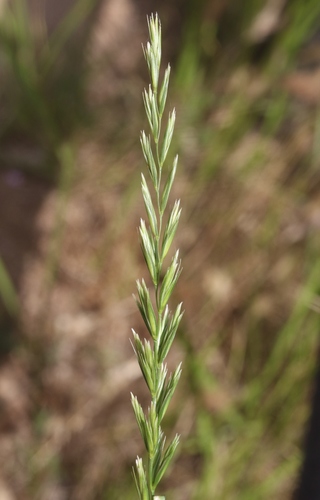
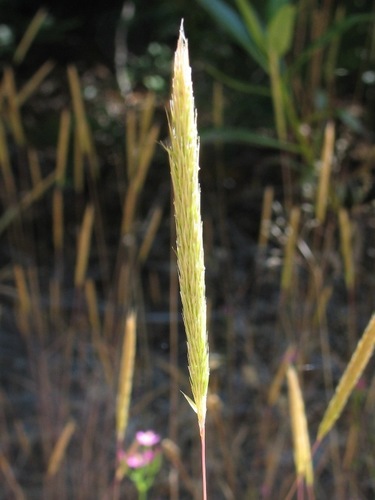
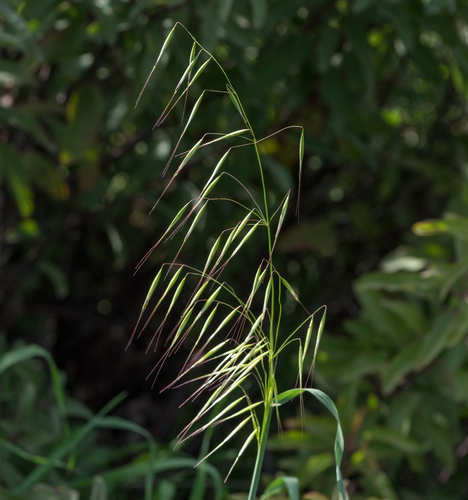
Avena barbata Pott ex Link is a species of wild oat commonly known as slender wild oat. Its seeds are edible. This plant is a diploidized autotetraploid grass with a chromosome count of 2n=4x=28. Its diploid ancestors are Avena hirtula Lag. and Avena wiestii Steud, which have a chromosome count of 2n=2x=14. These two ancestors are classified as Mediterranean and desert ecotypes respectively, and together they make up a single species. A. wiestii and A. hirtula are widespread across the Mediterranean Basin, where they grow in mixed stands with A. barbata, though the three are difficult to distinguish from one another. Avena barbata is a winter annual grass with thin tillers, or stems, that reach a maximum height of 60 to 80 centimeters, and can sometimes grow even taller. Its bristly spikelets measure 2 to 3 centimeters long, not counting the bent awn which can reach up to 4 centimeters in length. In natural populations, Avena barbata reproduces largely by selfing, with very low outcrossing rates. This species is native to central Asia, reaching as far east as Pakistan, and the Mediterranean Basin. It has been introduced to other Mediterranean-like habitats in New Zealand, Australia, South Africa, Argentina, Chile, Brazil, and Uruguay. In Europe, it has been recorded in Finland, France, Germany, Norway, Bulgaria, and Austria. In North America, it is an introduced noxious weed that is especially widespread in California, where it has displaced native grass species. It can also be found in Oregon, Washington, Hawaii, Massachusetts, Nevada, Arizona, and New Mexico. Genetic evidence shows that the A. barbata populations found in Argentina and California originated from Spain, introduced during the Spanish colonization of the Americas.