About Avahi laniger (Gmelin, 1788)
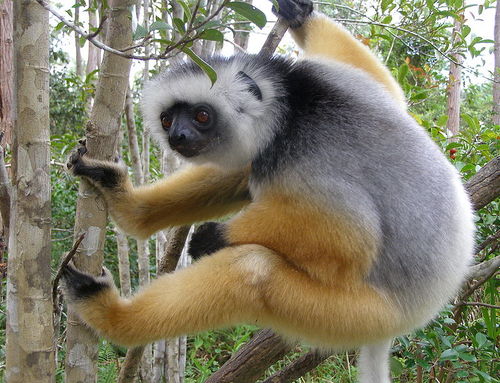
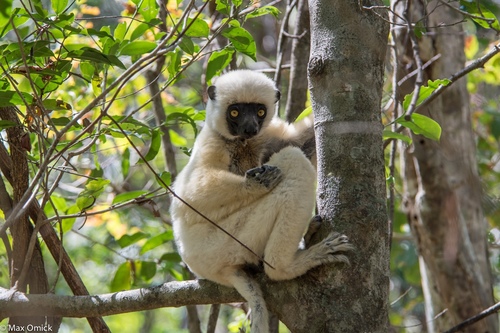
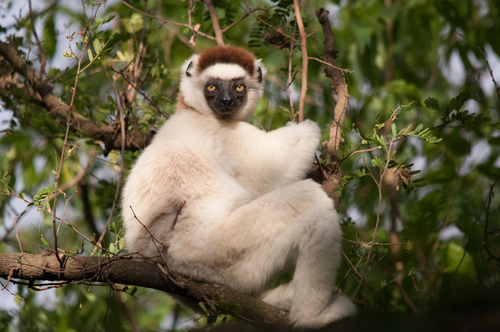
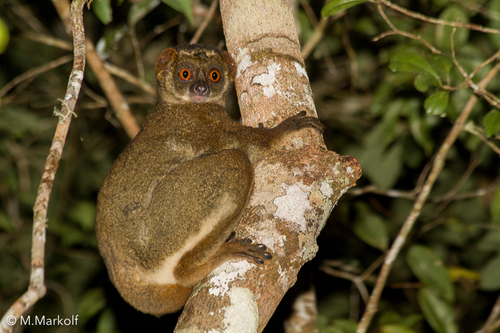
The eastern woolly lemur, scientifically named Avahi laniger, is also known as the eastern avahi or Gmelin's woolly lemur. It is a species of woolly lemur native to eastern Madagascar, where it lives in wet tropical rainforest at low elevations along the island's eastern coast. It can also inhabit the island's northern tip alongside other lemur species. The common name "woolly lemur" refers to the species' thick, tightly curled hair, while its generic name avahi refers to its high-pitched defensive call. Eastern woolly lemurs have an owl-like appearance, with large eyes, a small rounded head, and mostly hidden ears. This nocturnal animal weighs 1.0–1.3 kg (2.2–2.9 lb), reaches a body length of 27–29 cm (11–11 in), and has a tail measuring 33–37 cm (13–15 in). Its diet is mainly made up of leaves and buds, and also includes fruits, flowers, and bark. Eastern woolly lemurs live in monogamous pairs along with their offspring. The species' breeding season runs from March to May, and offspring are born around August to September. Diademed sifaka (Propithecus diadema) and red-bellied lemur (Eulemur rubriventer) are other lemur species that share the same rainforest habitats as the eastern woolly lemur. In southeastern rainforests, sympatric lemur species of A. meridionalis include the brown mouse lemur (Microcebus rufus), the greater dwarf lemur (Cheirogaleus major), and the fat-tailed dwarf lemur (Cheirogaleus medius), alongside collared brown lemur (Eulemur collaris) in Sainte Luce Forest, and the southern lesser bamboo lemur (Hapalemur meridionalis) in Mandena Forest. According to one study, a male eastern woolly lemur rarely interacts with more than one other individual when sleeping, traveling, or grooming. At night, a male spends about 40% of his time with his partner, either grooming or resting. Eastern woolly lemurs have sleeping site preferences: they prefer to sleep on branches or in dense vegetation at an average height of 3 m. As of 2020, the eastern woolly lemur still exists. However, a 2000 study notes that the entire lemur population may become endangered if forests continue to disappear at a disastrous rate, which can be driven by factors such as deforestation and forest degradation.