About Autographa gamma (Linnaeus, 1758)
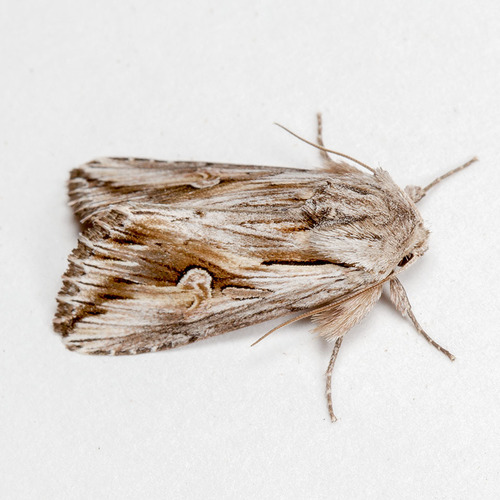
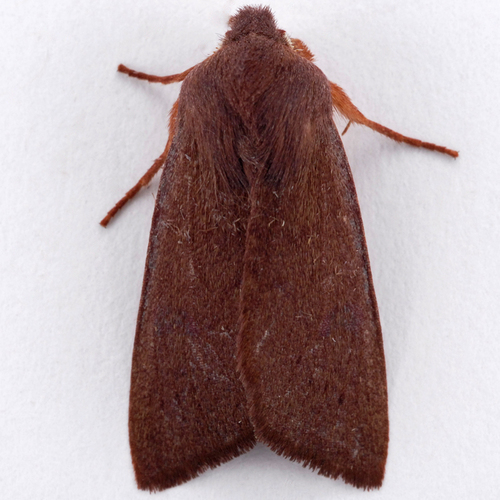
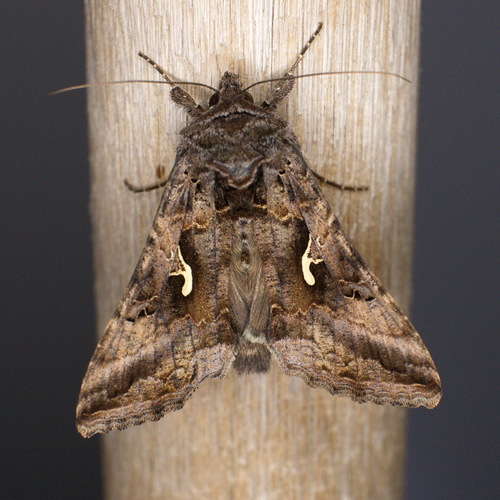
Autographa gamma, commonly called the silver Y, is a medium-sized moth with a wingspan of 30 to 45 mm. Its wings feature intricate patterning in various shades of brown and grey, which provides excellent camouflage. At the center of each forewing, there is a silver-colored mark shaped like a lowercase y or the lowercase Greek letter gamma. Multiple different color forms exist, with variation dependent on the climate where larvae develop. For technical description and variation: The forewing of P. gamma is purplish grey, with darker suffusion in some areas; the lines are pale silvery, edged on both sides with dark fuscous. The outer line is indented on vein 2 and the submedian fold, as seen in circumflexa. The oblique orbicular and the conversely oblique reniform are constricted in the middle, and both are edged with silvery. The median area below the middle is blackish, and contains a silvery gamma-shaped mark. The subterminal is dentate and indented, preceded by a darker shade. The hindwing is brownish grey with darker veins and a broad blackish terminal border. Aberrations based on ground color include ab. pallida Tutt, which has a whitish grey ground color, making the markings darker and more sharply defined; ab. rufescens Tutt, which has yellowish red ground color, with a pale golden gamma mark, pale golden lines and stigma edges, and an entirely reddish underside; and ab. nigricans Spul., in which the whole forewing up to the pale terminal space is violet black brown. In ab. purpurissa ab. nov. (65a), the ground color is deep olive brown; the inner and outer lines are violet, with the outer line double. The subterminal line is lustrous violet, irregularly waved, and below the middle forms a strong W-shaped mark. The gamma mark is pale golden, and the edges of the dark stigmata, like the inner line, are finely lustrous. A pale violet terminal stripe sits before the termen, and the hindwing is bronzy brownish with a broad dark terminal border. The specimen this description is based on, now held at the Tring Museum, was collected in Sussex on the South Coast of England, and is referenced by Tutt in British Noctuae, Volume IV, page 32. Finally, the form gammina Stgr., from Syria and Pontus, is only half the size of typical A. gamma, with more distinctly marked forewings. The larva is pale green, with fine whitish or yellowish, partly double lines; it has a straight yellowish lateral line positioned above the white black-ringed spiracles. This species is widespread across Europe and nearly all of the Palearctic region, including North Africa. It is resident in the southern part of its range, and adults can fly almost year-round. In spring, variable numbers migrate north, reaching as far as Iceland, Greenland, and Finland, with huge invasions occurring in some years. A second wave of migrants arrives in summer. In central Europe and the British Isles, adults are present in significant numbers starting in May, and numbers decline in late autumn when individuals are killed by frost. Some individuals migrate south again to winter around the Mediterranean and Black seas. It occupies a wide variety of habitats, particularly open areas, and regularly visits gardens to feed on nectar from flowers.