About Autographa bractea (Denis & Schiffermüller), 1775
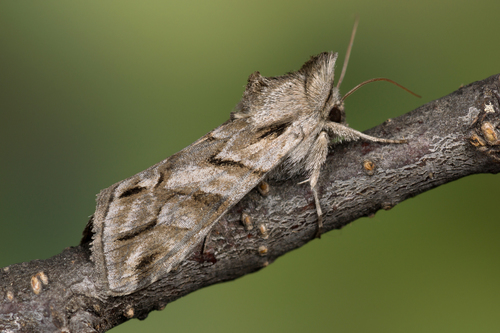
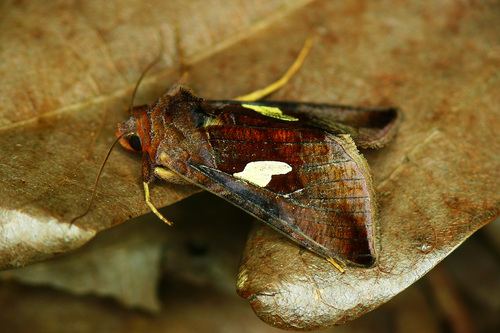
The gold spangle, with the scientific name Autographa bractea (Denis & Schiffermüller), 1775, is a moth of the family Noctuidae. This species was first described by Michael Denis and Ignaz Schiffermüller in 1775. It is distributed across Europe, western Siberia, the Altai Mountains, the northern Caucasus, northern Turkey, and northern Iran. The forewings are purplish fuscous, marked with many fine dark strigulae. The lines are fine, dark, and indistinct, and run inwardly oblique. Below the middle, the inner line is finely golden; the outer line is golden only at the inner margin. Below the middle of the median area, the color is ferruginous brown, and it contains a large irregular, somewhat sinuous shining golden blotch at the base of vein 2. This golden blotch varies in shape, ranging from a subquadrate, somewhat anvil-shaped mark to an elongate, sinuous, tongue-shaped one. A deeper diffuse shade runs from the apex to the middle of the wing. The hindwings are dull bronzy yellowish, tinged with fuscous, and the terminal area is diffusely deep fuscous. Full-grown larvae are pale green, with white dorsal and spiracular lines. Their pale green heads are marked with brown. The wingspan of this species ranges from 42 to 50 mm.