About Austrothelphusa transversa (von Martens, 1868)
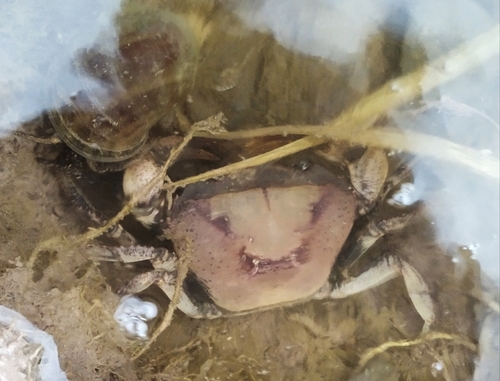
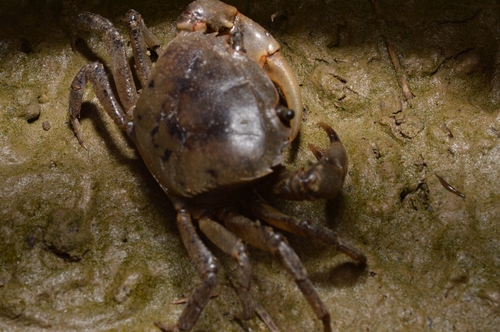
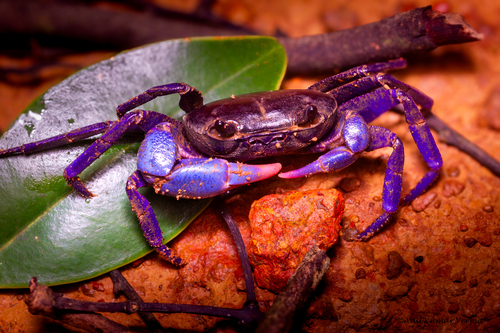
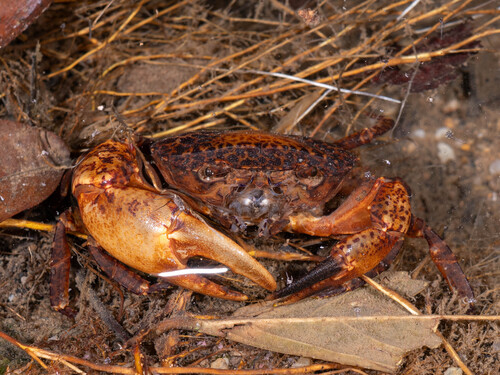
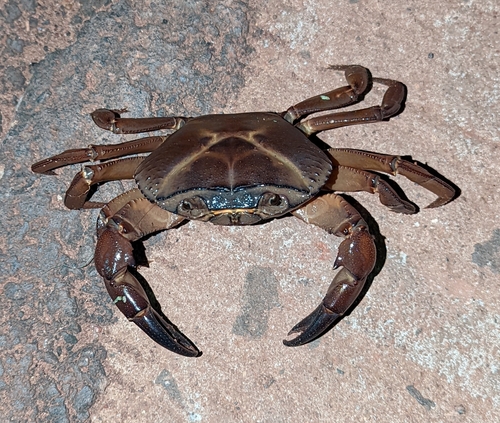
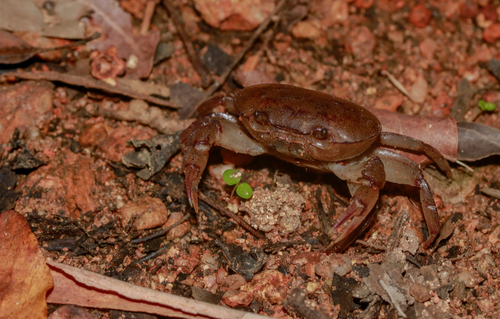
Taxonomy and description This species, commonly called the inland crab, has undergone numerous changes to its scientific classification, including revisions to its specific name, and reassignments across different genera, subgenera, and subfamilies such as Parathephusa, Liotelphusa, and Holthuisana. Due to the loss of the original type specimens, morphological similarities between certain related genera, and the most recent molecular testing, the species is currently placed alongside six other species in the genus Austrothelphusa, giving it the accepted scientific name Austrothelphusa transversa (von Martens, 1868). The coloration of the inland crab varies between individuals; most individuals have an exoskeleton in shades of brown, maroon, grey, or a similar mix of these tones. The inland crab has a relatively smooth carapace that reaches approximately 5 cm (2.0 in) in diameter. Like all other decapods, the inland crab has one pair of claws (with one claw longer than the other), four pairs of walking legs, and a generally round carapace.
Distribution and habitat The inland crab is endemic to the Australian mainland, and is widely distributed across the north-western half of the continent. It can survive in both the arid inland conditions of central Australia, and the tropical and sub-tropical rivers of northern Australia. It is predominantly found in ephemeral rivers, creeks, and waterholes across Queensland (QLD) and the Northern Territory (NT). It also occurs in isolated pockets in the north-eastern parts of Western Australia (WA) and South Australia (SA), as well as in parts of north-western New South Wales (NSW).
Reproduction Female inland crabs carry fertilized eggs tucked under their abdomen, which is held against the underside of the thorax. A single female can lay between 100 and 350 eggs. Females retain their eggs and offspring through all of larval development, up to the early juvenile stage. Once the young reach this stage, the mother releases them into the nearby environment to live independently. It is thought that mothers retain their young inside their burrows during the aestivation period, only releasing the young once they exit aestivation. This behavior protects the young through the harshest season of the year, and gives them the best possible chance of survival once waterways refill after the dry period.