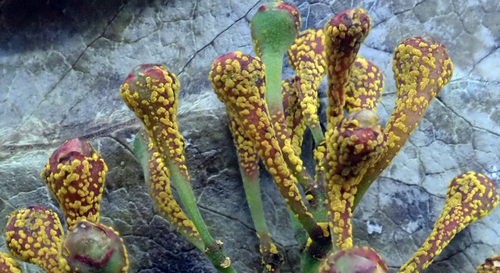
About Austropuccinia psidii (G.Winter) Beenken
Austropuccinia is a monotypic genus of rust, a type of plant pathogenic fungus, native to South America. Its only species is Austropuccinia psidii, which is commonly known as myrtle rust, guava rust, or ʻōhiʻa rust. This fungus belongs to the guava rust (Puccinia psidii) fungal complex group, and infects plants in the family Myrtaceae. Its spores have a distinctive yellow to orange colour, and are occasionally surrounded by a purple ring. The spores appear on lesions on new host growth, including shoots, leaves, buds and fruits. Infected leaves become twisted and may die, and infection can kill the entire host plant in highly susceptible species. As of late 2013, the pathogen was infecting around 179 species across 41 genera in New South Wales and Queensland, Australia; this accounts for around 46% of all genera within the Myrtaceae. Rust fungi typically have complex life cycles that include sexual and asexual reproduction stages, which sometimes occur on evolutionarily unrelated host plants. The life cycle of Austropuccinia psidii remains controversial: one study concluded the species is autoecious, while another found it to be heteroecious with an alternate host that has not yet been discovered. This fungus acts as a polycyclic pathogen, with four distinct stages in its disease cycle. In Stage I, aeciospores inoculate young leaves, shoots, fruits, and flower buds. After infection, aeciospores germinate and penetrate the host by forming a haustoria. Colonies and urediniosori form after this penetration. In Stage II, urediniospores are produced and go on to inoculate new young leaves, shoots, fruits, or flower buds; this step enables secondary infection and supports the pathogen’s polycyclic nature. During Stage II, urediniospores also germinate and penetrate the host, leading to the development of new urediniosori. In Stage III, urediniospores germinate, penetrate the host, and develop a haustoria. After penetration, colonies form and teliosori develop. Teliosori produce teliospores that can germinate further; once germinated, basidiospores develop. In Stage IV, basidiospores spread and inoculate young leaves, shoots, fruits, and flower buds. The basidiospores then germinate, penetrate the host, and develop a haustorium. An aeciosori forms that produces new aeciospores, and the cycle begins again.

