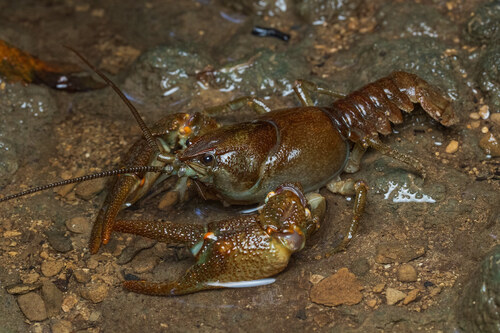
About Austropotamobius torrentium (von Paula Schrank, 1803)
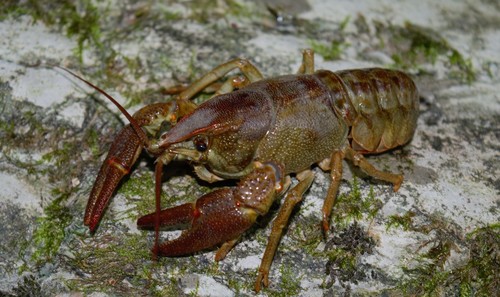
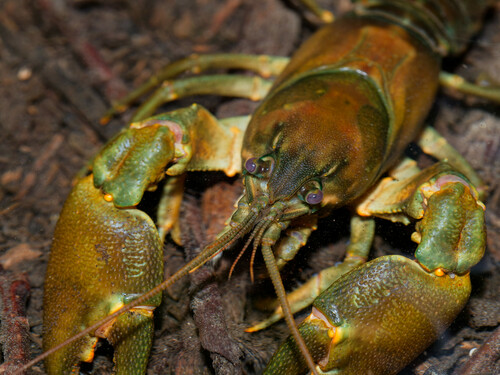
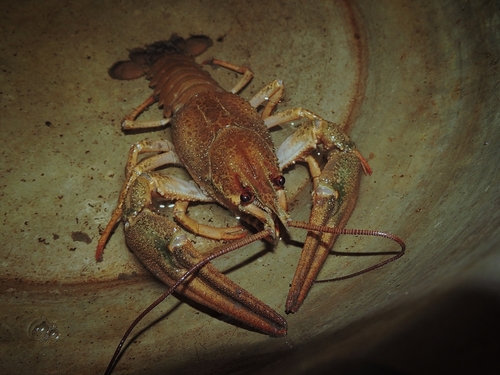
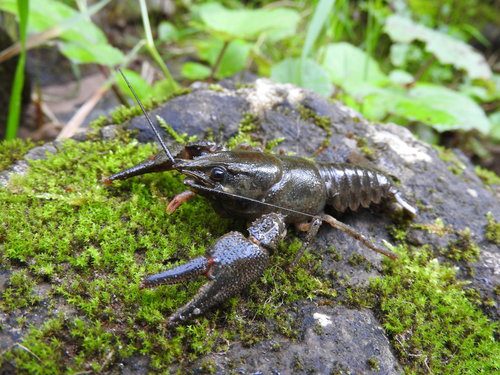
Austropotamobius torrentium grows to around 10 centimetres (4 inches) in length, with a smooth brown carapace and an untoothed triangular rostrum, while its underside is creamy white. Males of this species have larger claws than females, and females have a noticeably larger abdomen. Like other crayfish, the first two pairs of male pleopods are modified for sperm transfer, while female pleopods are uniform and used for brooding eggs. The distribution of A. torrentium is centered on the Danube system. It extends from the Olt River in Romania upstream to Germany and Switzerland, and reaches into parts of the Rhine and Elbe basins. The species is widespread across southern Germany, Switzerland, Austria, Hungary, Slovenia, Croatia, and Serbia. Contrary to some earlier records, A. torrentium does not currently appear to occur in Luxembourg, Poland, or Ukraine. In France, which forms the western edge of the species' range, only two populations remain: one in Alsace and one in Lorraine. The Czech Republic and Slovakia lie at the north-eastern periphery of A. torrentium's natural range, with only four known populations in the Czech Republic and six known populations in Slovakia, all of which are located in the Male Karpaty (Lesser Carpathians) hills. The northernmost point occupied by A. torrentium is near Dresden, in the German state of Saxony. Italy forms the south-western margin of the species' distribution, with at least two populations found in the Slizza drainage, a Danube tributary near Tarvisio. To the south-east, the species has reached the Drin River in Albania, and a population was discovered in the European part of Turkey in 2005. In Romania, A. torrentium occurs in the Apuseni Mountains and the south-western Carpathian foothills, with a small overlap in range with the noble crayfish Astacus astacus. Populations on the western edge of A. torrentium's range are genetically depauperate. Populations from the upper Kupa basin are as genetically distinct from the rest of A. torrentium as different species in related genera are from one another, which suggests the species originated in the Western Balkans. A. torrentium prefers cold, fast-flowing streams as its habitat, though some individuals live in larger rivers and lakes. It digs burrows in stream banks, hides under submerged roots or rocks, and emerges at night to feed. Adult A. torrentium eat a variety of plant materials, including fallen leaves, while juveniles feed primarily on aquatic invertebrates. Natural predators of fully grown A. torrentium include foxes, bears, wolves, otters, and badgers, while young individuals are preyed on by fish. This species is sensitive to low dissolved oxygen levels and chemical pollution. In addition to natural threats, A. torrentium has been negatively impacted by the introduction of crayfish plague (Asphanomyces astaci), which is carried by invasive North American crayfish species, and by the release of laundry detergents into streams during clothes washing. Mating occurs at the end of October. After mating, the female carries 40 to 70 fertilised eggs on her pleopods until the eggs are ready to hatch. Juveniles moult up to 4 or 5 times each year; once they reach maturity, moulting slows to once or twice a year, typically occurring in May, June, or July. Sexual maturity is reached after 3 to 5 years, when individuals have grown to 35–50 millimetres (1.4–2.0 in) in length. Adult males can reproduce every year, but females do not reproduce for at least one year after producing a clutch of eggs.