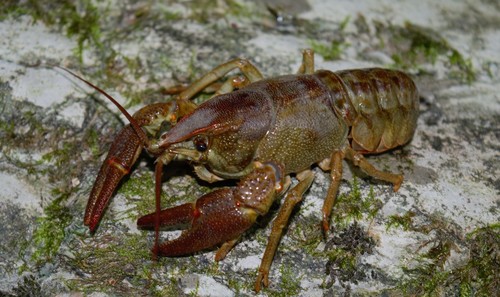
About Austropotamobius pallipes (Lereboullet, 1858)
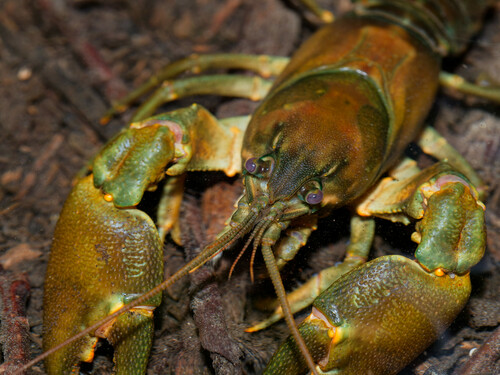
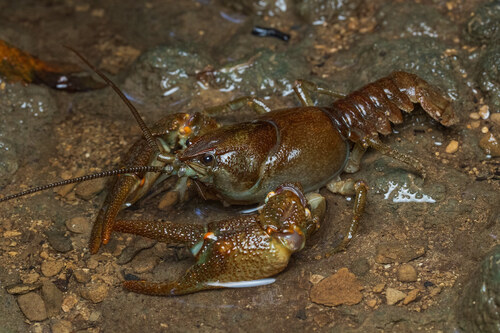
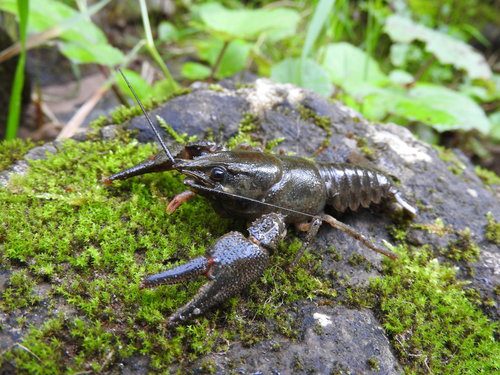
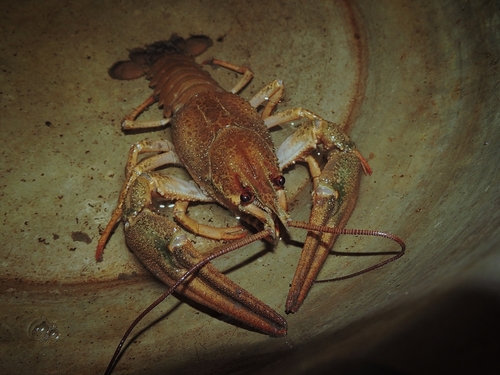
Austropotamobius pallipes is an olive-brown crayfish, named for the pale undersides of its claws (the specific Latin epithet pallipes means "pale feet"). It can reach a maximum length of 12 cm (4.7 in), though most common adult sizes are below 10 cm (3.9 in). This species typically lives in around 1 meter (3 ft) deep rivers and streams, as well as in lakes; it hides among rocks and submerged logs, and emerges to forage for food.
Its native distribution ranges from the eastern Balkan Peninsula to Spain, with its northern limit reaching Great Britain. It also occurs in Ireland, where it is considered an introduced species, and is the only crayfish found in Ireland. Across its range, it is restricted to certain regions, with the highest densities found in chalk streams. In Ireland, it occurs over limestone areas in rivers, streams, canals, and lakes. In France, it is found in small streams including the Mornante and Sellon, two small tributaries of the Dorlay in the Loire department, where it is protected as a heritage species. It is also an emblematic species for many French Natura 2000 sites. The species has become increasingly uncommon in France: it was previously present in most French rivers, until North American crayfish species were introduced there in the 20th century. It has also been introduced to Corsica, Liechtenstein, and Portugal; the population in Portugal is now extirpated.
In Great Britain, the species was once found across most of the country, but its distribution is rapidly shrinking. Current recorded populations are in Yorkshire, central and northern England, east Kent, eastern Wales, the Candover Brook (a tributary of the Itchen in Hampshire), parts of Essex, and several long headwaters of the River Thames. In these areas, A. pallipes competes with the introduced noble crayfish, which itself faces competition from the introduced signal crayfish. A population of the species is present at Dowdeswell Reservoir, Gloucestershire, and Severn Trent protected the species during reservoir works carried out in 1998. Disease carried by invasive species eradicated the population from the naturally alkaline River Frome, Bristol, between 2007 and 2008.
Ecologically, A. pallipes is absent from more acidic waters. It occurs in moderately flowing streams, alongside other freshwater invertebrates including caddis flies, mayflies, and molluscs. Its shared habitat also includes trout and three-spined stickleback. Shelter is provided by tree roots and bank-side rocks. Juvenile A. pallipes shelter in vegetation such as watercress and grass mats that grow out from the banks.