About Austropaxillus infundibuliformis (Cleland) Bresinsky & Jarosch
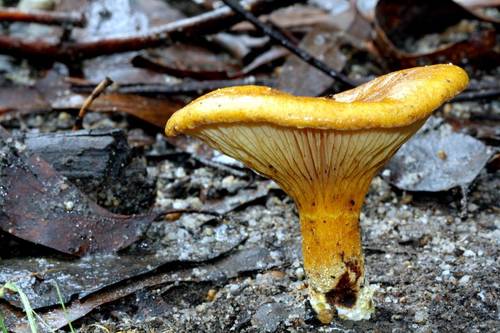
Austropaxillus infundibuliformis is easily recognized by its large size for an Australian mushroom, its colour, and its gills. Young caps are convex to flattened with an inrolled margin, and reach up to 6.5 cm (2.6 in) in diameter. As the mushroom matures, the cap develops a central depression, becomes funnel-shaped, and its margin becomes wavy and folded. Cap colour ranges from yellow-brown to dark brown, with a dry, felt-like surface that sometimes develops small cracks as it ages. The gills are closely spaced, pale cream to pale yellow-brown, decurrent, and interspersed with short gills called lamellulae. They are shallow, reaching up to 4 mm deep, have smooth edges, are multiply forked, and can be easily separated from the cap flesh. The stipe grows up to 4.7 cm (1.9 in) long and 1.7 cm (0.7 in) thick; it is yellowish with lighter colouring near the base, and bruises dark brown when injured or handled. The flesh has no distinctive odour and a bitter taste. The spore print is brown, and the spores are somewhat fuse-shaped, thick-walled, and measure 11–13 by 5–6 μm. Austropaxillus infundibuliformis is a mycorrhizal species found across southern Australia, with recorded occurrences from Western Australia east to Victoria and New South Wales. It fruits on the ground in eucalypt forests, including forests of Eucalyptus obliqua. Watling and colleagues examined a Tasmanian specimen from Mount Field that was originally regarded as A. infundibuliformis, and found it to have smaller spores and paler gills.