About Austrocylindropuntia subulata (Muehlenpf.) Backeb.
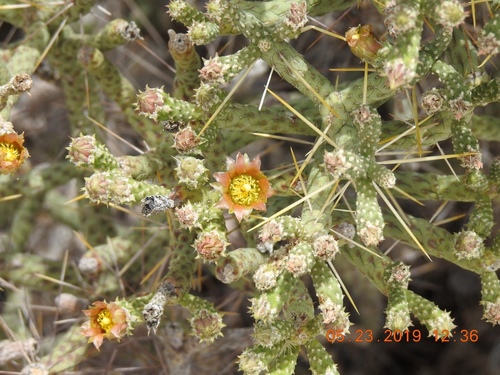
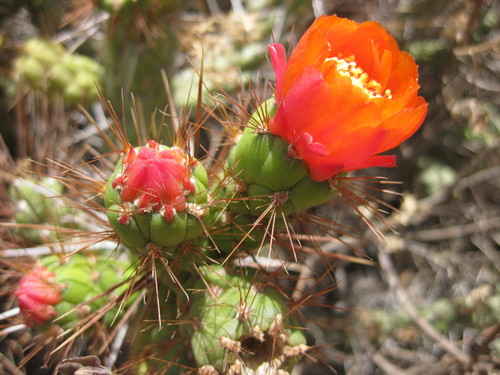
Austrocylindropuntia subulata can grow to heights of up to 4 metres (13 ft), and produces numerous branches. Its elongated, slightly brittle branches reach up to 50 centimetres (20 in) in length. The stems feature rhomboid to ovate bumps arranged in a few spiral rows. Each bump has an areole at its tip, which produces one to four straight, grayish-white spines that grow up to 8 centimetres (3 in) long. This cactus has awl-like rudimentary leaves that can reach up to 12 centimetres (5 in) long. Its orangy-pink flowers grow to 6 centimetres (2+1⁄4 in) long. The long, warty hypanthium is covered in rudimentary leaves up to 2 centimetres (3⁄4 in) long. Fruits of A. subulata are ovoid or club-shaped, sometimes thorny, and grow up to 10 centimetres (4 in) long.
A. subulata is thought to originate from the Peruvian Andes, where it is common at altitudes above 3,000 metres (9,800 feet). It is now naturalized in Argentina and Bolivia. It was introduced to the Mediterranean basin to create impassable hedges, but has become invasive in coastal provinces and parts of the interior of the Iberian Peninsula. It is also invasive in Australia, where it is listed as a declared Weed of National Significance.