About Austrocortinarius australiensis (Cleland & Cheel) Liimat. & Niskanen
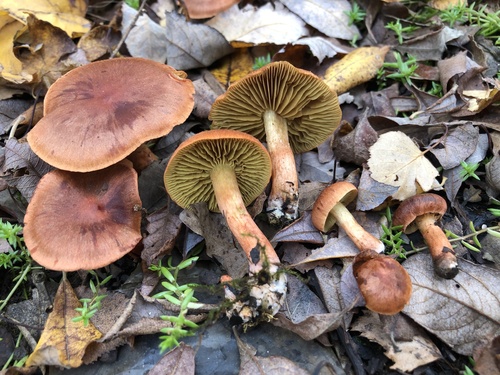
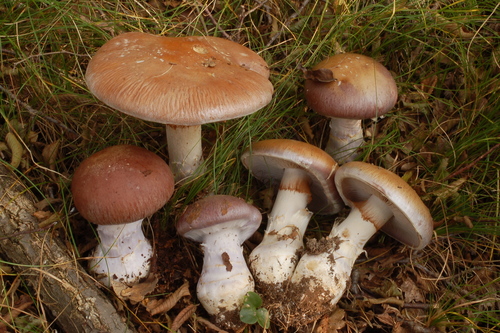
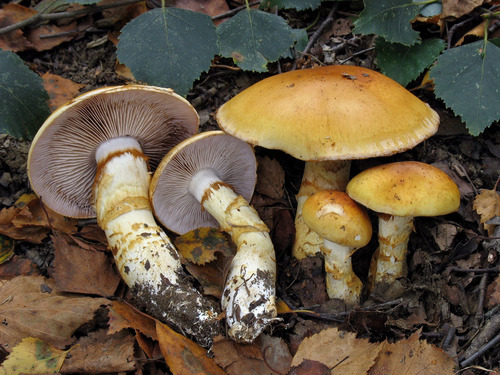
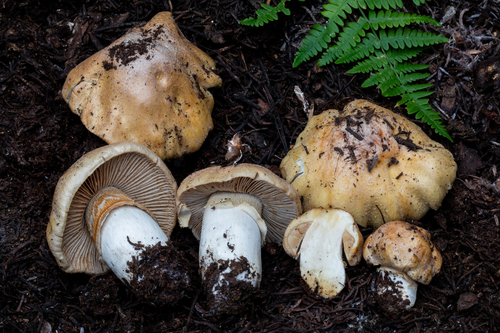
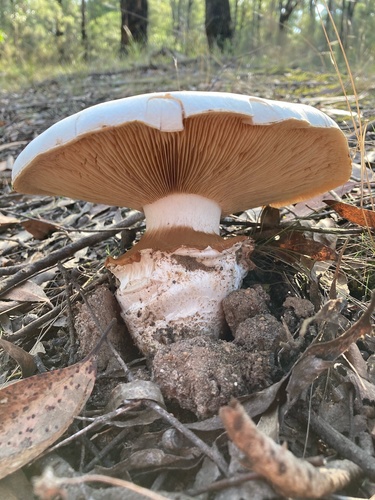
The fruitbodies of Austrocortinarius australiensis have caps that range from convex to flattened in shape. Most caps measure 5 to 7.5 cm (2.0 to 3.0 in) in diameter, though specimens as large as 30 cm (12 in) have been recorded. This fungus has no noticeable odour. Caps are whitish with brown tints, and ragged fragments of the partial veil frequently remain attached to the cap margin. The stipe is bulbous, with a maximum recorded length of 15 cm (5.9 in) and width of 3.7–6.2 cm (1.5–2.4 in), though stipes are often much smaller than these maximum measurements. On the underside of the cap, gills are initially adnately attached to the stipe and pale straw in colour. As the mushroom matures and spores develop, the gill attachment shifts to sinuate or nearly free, and the gill colour deepens to rusty brown. Gills can grow up to 1 cm (0.4 in) deep. Remnants of a ring often remain on the stipe when the mushroom reaches maturity, along with fragments of the universal veil that originally enclosed the immature fruiting body. The ring is often stained dark brown from spores that have fallen from the gills. Spores are ellipsoid to almond-shaped, measuring 10–13 by 5.4–6.9 μm, and turn yellowish brown when tested with KOH. Specimens collected in Western Australia have slightly larger spores, with an average size of 11.1 by 5.9 μm. The edibility of A. australiensis is unknown, and it is recommended that people avoid eating it, because many of its close relatives produce lethal toxins. Young fruitbodies of this species can look very similar to fruitbodies of Amanita ovoidea. A. australiensis may also be confused with the similar species Cortinarius sublargus, commonly called the dumpy webcap. C. sublargus is generally smaller, lacks a prominent ring, and typically only grows in recently burnt areas. In Australia, A. australiensis has been recorded in New South Wales, and in the Mount Lofty Ranges, Kuitpo and Ashton regions of South Australia. It has also been found in the wet forests of Tasmania, where it is a rare species. This fungus forms mycorrhizal relationships with eucalypts. Large clusters of fruitbodies develop in eucalypt forests between April and July. In the Jarrah forests of southwestern Australia, A. australiensis produces the largest mushrooms of any native species, and its fruitbodies are often eaten by native mammals. The species also occurs in New Zealand, where it grows in association with Leptospermum.