About Austroboletus subflavidus (Murrill) Wolfe
Austroboletus subflavidus is a bolete fungus species belonging to the family Boletaceae. This fungus is found in eastern North America, and its fruit bodies grow near oak and pine trees. William Murrill, an American mycologist, originally described this species as a member of the genus Tylopilus in 1938. Carl B. Wolfe later transferred it to the genus Austroboletus in 1980.
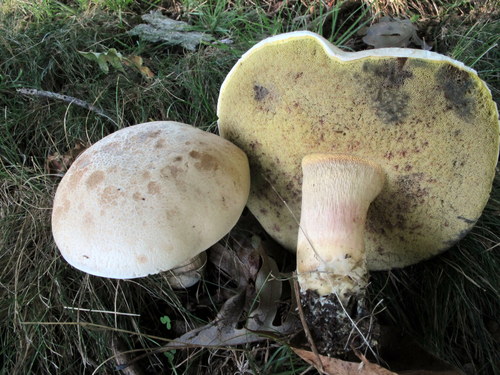
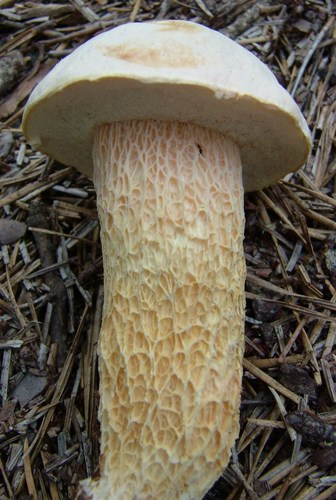
The fruit body of Austroboletus subflavidus has a cap that ranges in color from white to yellowish, and in shape from convex to flattened. The cap has a diameter between 3 and 10 centimeters (1.2 to 3.9 inches). On the underside of the cap, the pores are about 1 millimeter wide. They start off white to grayish in color, and turn pinkish as they mature. The stipe (stem) of the fruit body is coarsely reticulate (net-patterned) and pitted. It measures 4.5 to 14.5 centimeters (1.8 to 5.7 inches) long, and 0.7 to 3 centimeters (0.3 to 1.2 inches) thick. The spore print of this fungus is reddish brown. Its individual spores are spindle-shaped (fusiform), and measure 15–20 micrometers long by 6–9 micrometers wide.