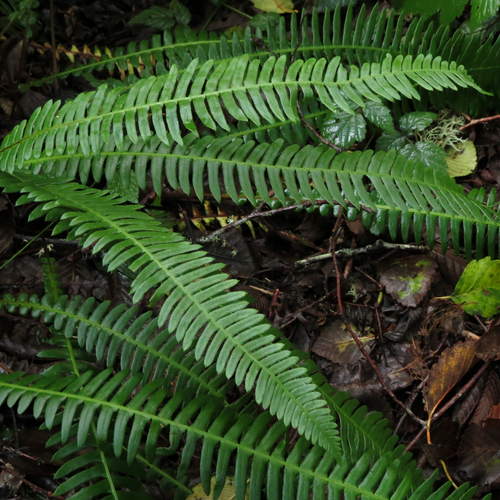
About Austroblechnum durum (T.Moore) Gasper & V.A.O.Dittrich
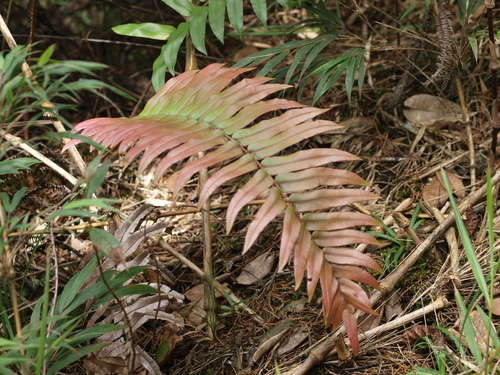
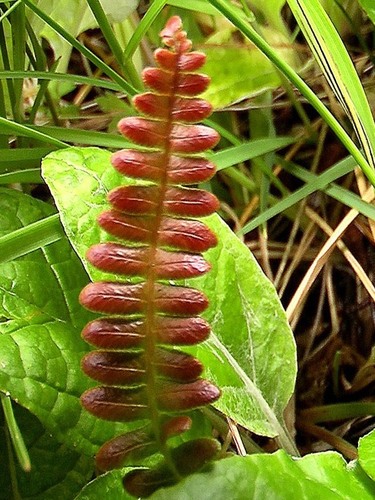
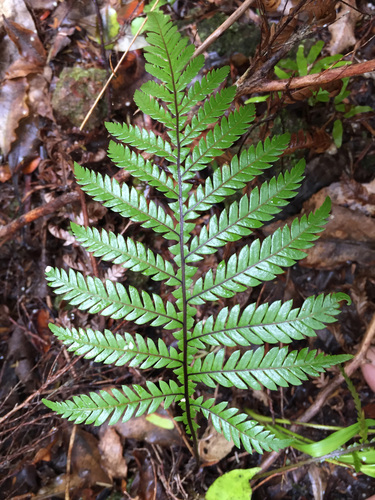
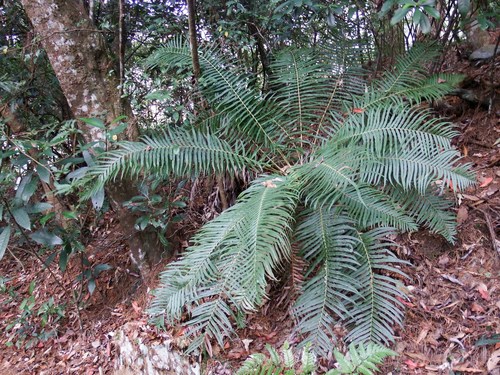
This species was originally described by Thomas Moore as follows: Its fronds are pinnate toward the base, lanceolate in shape, and have a fleshy, leathery texture. Fronds measure 1 foot or more in length. Pinnae or segments are closely spaced, separated by a narrow gap, not merged together, with blunt tips, smooth edges, and slightly distinct margins. Middle pinnae are oblong and somewhat sickle-shaped. Pinnae get smaller toward the frond tip, tapering into an acuminate apex, while lower pinnae are reduced into rounded lobes. Veins are forked, with slightly club-shaped ends. The overall frond form is lanceolate, ending abruptly in a tail-like tip, with moderately broad, densely packed, very blunt pinnae that curve upward. Pinnae are slightly decurrent on their forward edge, and bear a small, separate lobe-like auricle at this position. Sori are located along the frond margin. The indusium is narrow, transversely wrinkled, and has irregularly torn, fringed margins. The caudex is erect and subarborecent. Stipes are 1 inch long, with ovate-lanceolate scales at their base. The rachis is prominent, bluntly keeled on its back side, and grooved on its front side. Austroblechnum durum has a somewhat restricted distribution. It grows in coastal forests from south of Okuru and the Haast River eastward to the Catlins area of New Zealand's South Island. It is also found on Stewart Island, where it grows on the forest floor of mixed hardwood/podocarp forests alongside Austroblechnum leyboldtianum, A. lanceolatum and A. colensoi.